Fit, Sweat & Safety Guides · Guide
Waterproof vs water-resistant earbuds: one of those words means nothing, and so does the other
No standards body defines either term. IEC 60529 defines IP codes, and that is the only water claim on an earbud box that has a test behind it. Here is how to read the code, and what each level actually lets you do.
By Mike M.Updated Researched · every spec sourced
#adReader-supported: we may earn a commission if you buy through our links, at no extra cost to you. It never decides a ranking. How we rank · Disclosure
The direct answer
Why neither word is regulated
Partly history, partly because “proof” is not a meaningful engineering concept here. Everything fails at some pressure and some duration, so the standard describes conditions rather than absolutes: how much water, delivered how, from what angle, for how long.
That is why the two phrases drift. A manufacturer describing an IPX4 bud as water-resistant is being reasonable. A manufacturer describing the same IPX4 bud as waterproof is being optimistic, and nothing stops them. You will also see “sweatproof,” “splash-proof,” “rain-ready” and “SweatGuard” — all of which are brand language layered on top of, or instead of, a rating.
Two honest examples from our own registry. Soundcore's V30i page says “IPX5 with SweatGuard” — the IPX5 is the claim, SweatGuard is the name of their internal sealing approach. And Soundcore's Sport X20 page lists IP68 in its product imagery and IPX7 in its written description; both are immersion ratings, they disagree with each other, and we report the disagreement rather than quoting the flattering one.
The only claim that means something
An IP code is IP followed by two characters. First character: protection against solid objects, 0 to 6. Second character: protection against water, 0 to 9. Either can be replaced by an X, which means that property was not tested.
For earbuds the first digit is almost always 5 (dust-protected: dust enters but does not interfere) or 6 (dust-tight: no ingress). The second digit is where the money is, and it is not a linear scale — the tests are qualitatively different at each step.
What each rating actually permits
| Rating | The test behind it | What you can actually do | Example on this site |
|---|---|---|---|
| IPX4 | Splashing water from any direction | Light sweat, a shower of rain. No dust claim at all. | Bose Ultra Open, Beats Powerbeats Pro 2 |
| IP54 | Dust-protected plus splashing | The floor. Fine for walking, marginal for heavy sweat. | Shokz OpenFit Air, Nothing Ear (open) |
| IP55 | Dust-protected plus a 6.3 mm jet from any direction | Heavy sweat, rain, a wipe-down. Our floor for training. | Shokz OpenFit 2 buds, Soundcore AeroClip |
| IP66 | Dust-tight plus powerful jets | Any downpour, a hose. Not a dunk. | Suunto Wing 2, JLab Epic Sport ANC 3 |
| IP57 | Dust-protected plus immersion to 1 m for 30 minutes | Rinse under a tap. Not laps. | Shokz OpenDots 2 buds, Apple AirPods Pro 3 |
| IP67 | Dust-tight plus immersion to 1 m for 30 minutes | Rinse the salt off. Shokz still says not for swimming. | Shokz OpenRun Air 2, Baseus Bowie MC2 |
| IPX7 / IPX8 | Immersion to 1 m, or deeper at a maker-stated depth; dust untested | Submersion, with no dust guarantee. | Cleer ARC 5 (IPX7), Creative Outlier Free Pro (IPX8) |
| IP68 | Dust-tight plus immersion deeper than 1 m, depth stated by the maker | Swimming, if the product also solves the radio problem. | Shokz OpenSwim Pro (2 m), Mojawa Run Plus |
Two counterintuitive points fall out of that table. First, IP57 is better than IP66 for water and worse for dust — the digits are independent, so you cannot rank codes as single numbers. Second, the jump from 5 to 7 is the one that changes your habits, because it is the jump from “do not submerge” to “hold it under the tap,” and rinsing salt off before it dries is the single best thing you can do for a sweaty pair. The test conditions in detail are in IPX4 vs IPX5 vs IPX7, and the whole code is decoded in earbud IP ratings explained.
The X that costs you a guarantee
An X is not a zero. It means the property was never evaluated, which is a different and slightly worse situation: with a zero you know it failed, with an X you know nothing.
On earbuds the X is almost always in the first position — IPX4, IPX7, IPX8 — meaning no dust testing. For a gym bag with chalk in it, a dusty trail or a beach, that matters. The Creative Outlier Free Pro is IPX8: you can swim in it, and Creative makes no claim about sand. The Cleer ARC 5 is IPX7: immersion-rated, dust unknown.
Where you really want both digits is a product you train in daily. IP67 and IP68 give you dust-tight plus immersion, which is why the strongest ratings on this site are on bone conduction neckbands: a neckband has no lid, no hinge and no charging case, so there is nothing to seal in the first place.
Why “waterproof” is not enough to swim
This is the trap that costs people money, and no IP code warns you about it.
Bluetooth is a 2.4 GHz radio and water absorbs it within centimetres. H2O Audio states it plainly on its own product page: Bluetooth does not work underwater. So a pair can be rated IP68 to three metres and still go silent the moment your head goes under, because the problem is the link, not the seal.
Swim-capable models solve it by removing the radio from the chain and playing files stored on the device: 32 GB on the Shokz OpenSwim Pro, 8 GB on the Creative Outlier Free Pro, 32 GB on the Mojawa Run Plus, 8 GB plus a playlist-sync mode on the H2O Audio TRI 2 PRO. If a listing boasts a swim rating and mentions no onboard storage, it cannot be used for laps.
Note too that a maker can carry an immersion rating and explicitly decline the use case: Shokz prints “not for swimming” beside the OpenRun Air 2's IP67. The rating is about surviving water; the sentence is about what they will support. The swim set is ranked in best bone conduction headphones for swimming and the shower question is in IPX7 earbuds in the shower and the pool.
Water damage and warranties
An IP rating describes a laboratory test on a new unit in fresh water. Three things it does not cover, and all three matter more to you than the digit does:
- Salt. Sweat and sea water are corrosive in a way distilled test water is not. The seal may hold while the contacts corrode.
- Age. Gaskets compress and adhesives degrade. A two-year-old IP67 bud is not an IP67 bud; it is a bud that was IP67 when it was made.
- Pressure and temperature. The immersion tests are static and at ambient temperature. A hot shower, a jet, or diving into a pool all exceed the conditions tested.
Which is why most warranties exclude liquid damage regardless of rating, and why the rinse-and-dry habit beats trusting a number. What that habit looks like is in how to clean sweaty earbuds, and the failure mechanism is in can sweat damage earbuds?
Picks
Our picks for this
One pair at each rung of the ladder
Four products whose makers publish the figure rather than an adjective: a genuine swim model, a rinseable trainer, a budget immersion-rated set, and the one ear-hook that is immersion-rated at all.
Best for swimming
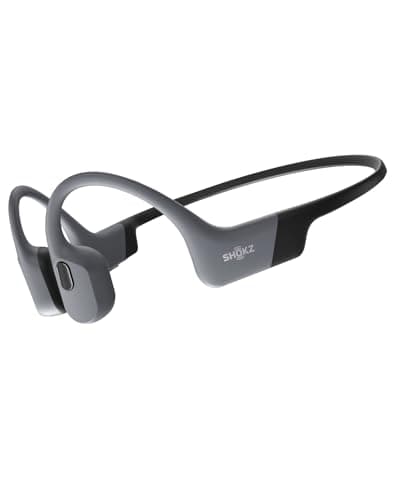
Shokz OpenSwim Pro
Bone conduction (neckband)8.5/10IP68 with a stated 2 m depth and 32 GB of storage, which is what 'waterproof' has to mean to be useful.
$229.95Amazon#ad · Price as of October 11, 2026 · Disclosure for the link to Shokz OpenSwim Pro
Best for heavy sweaters
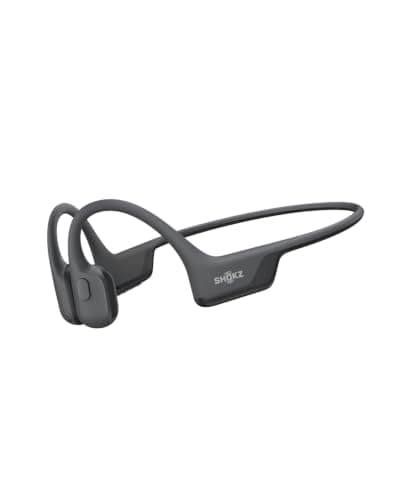
Shokz OpenRun Air 2
Bone conduction (neckband)8.7/10IP67: dust-tight and immersion-rated, so the salt comes off under a tap. Shokz still says not for swimming.
$129.95Amazon#ad · Price as of October 11, 2026 · Disclosure for the link to Shokz OpenRun Air 2
Best bone conduction under $100
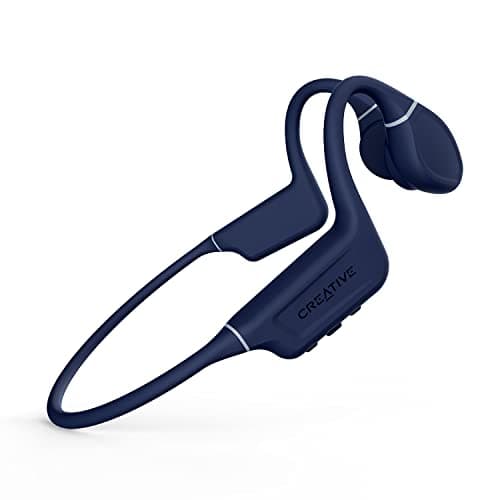
Creative Outlier Free Pro
Bone conduction (neckband)8.3/10IPX8 and 8 GB of storage for well under $100; the X means dust was never tested.
$59.99Amazon#ad · Price as of October 11, 2026 · Disclosure for the link to Creative Outlier Free Pro
Best water rating in an ear-hook
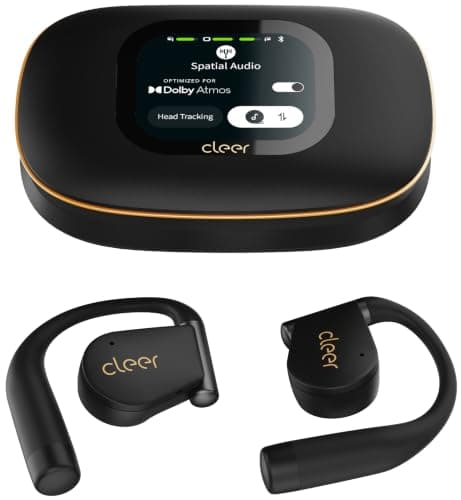
Cleer ARC 5
Open-ear hook8.6/10IPX7, the strongest water rating of any ear-hook here, with 12 hours per charge and every major codec.
$219.99Amazon#ad · Price as of October 11, 2026 · Disclosure for the link to Cleer ARC 5
How we scored this
The research behind every pick
Each pair on this page is researched and compared the same way: we classify the retention system that holds it on (hook, clip, wing, neckband), read the maker's published IP rating, weight, battery, charging, mic and control type straight off its own product page and manual, check the sweat and water rating against the IEC 60529 standard, cross-reference independent published reviews, and score every pick on a public rubric. Every figure links to the document it came from, so you can check any number in one click.
Prices come live from Amazon, so what you see is what you pay today. Commissions never set a score or decide a pick. The rubric and its weights are published.
Questions
Frequently asked
What is the difference between waterproof and water-resistant earbuds?
Are any earbuds truly waterproof?
Is IPX4 water-resistant enough for the gym?
Can I rinse my earbuds under a tap?
Does an IP rating last forever?
Keep reading
Related on Openear Club
Receipts
Sources
- IEC 60529 (IP Code) — degree-of-protection definitions, Keystone Compliance summary (checked 2026-09-21)
- IPX4 vs IPX5 test conditions (IEC 60529 nozzle, flow and duration), BONAD test-equipment summary (checked 2026-09-21)
- Shokz — official product comparison table (checked 2026-09-21)
- Shokz — OpenSwim Pro product page (checked 2026-09-21)
- Creative — Outlier Free Pro product page, specifications (checked 2026-09-21)
- Cleer Audio — ARC 5 product page, specifications (checked 2026-09-21)
- H2O Audio — TRI 2 PRO product page (checked 2026-09-21)
- Soundcore — V30i product page, specifications (checked 2026-10-03)
- Soundcore — Sport X20 product page (checked 2026-09-21)
Every spec here is traceable: figures come from the maker's own product pages and are linked on each product, independent findings are attributed to whoever published them, and prices come live from Amazon so the number you see is the number you pay today. Read the full method.