Open-Ear Earbuds · Guide
Do open-ear earbuds fall out? Hooks and neckbands hold; clip-ons just feel like they won't
The reason sealed earbuds work loose is that they are held in by friction against a canal that is changing shape and getting wet. Open-ear designs do not use that mechanism at all, which is why the failure mode mostly disappears. Mostly.
By Mike M.Updated Researched · every spec sourced
#adReader-supported: we may earn a commission if you buy through our links, at no extra cost to you. It never decides a ranking. How we rank · Disclosure
The direct answer
Why sealed earbuds fall out
Worth understanding, because it explains why open-ear designs sidestep it. A conventional earbud is held in by a silicone tip compressed against the walls of your ear canal. Three things conspire against that:
- Your canal changes shape. It flexes when you chew, talk, yawn or clench your jaw — which is most of what a face does during exercise. Each flex breaks the seal slightly and the bud creeps outward.
- Sweat is a lubricant. Friction is the whole retention mechanism and sweat reduces it. That is why the bud that was fine for twenty minutes starts migrating in the last mile.
- Impact supplies the energy. Footstrike sends a shock up your spine roughly twice a second, and a loose bud only needs a few millimetres of travel before the seal is gone and the bass with it.
Two people have asymmetric canals as well, which is why one side always goes first — covered in earbud keeps falling out of one ear.
The three open-ear designs, ranked for grip
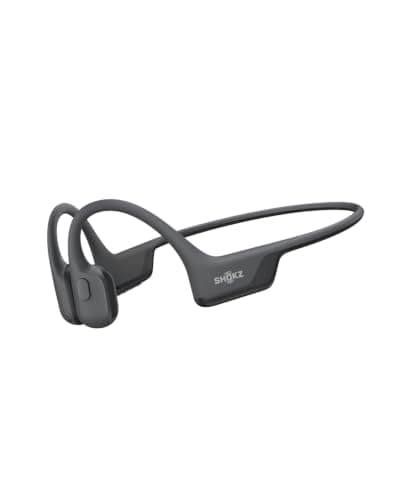
1. Bone conduction neckband — effectively cannot fall out
A sprung titanium band wraps the back of your head and holds two transducers against your cheekbones by pressure. Nothing touches your ear canal, nothing hooks over anything, and the anchor is your whole skull. There is no mechanism by which it works loose. People do burpees and inversions in these.
The one requirement: the frame has to match your head. Shokz sells Standard and Mini and publishes a head-circumference cutoff of about 9.25 inches. Too large an arc bounces on footstrike; too small clamps your temples. A one-size neckband is a gamble — see bone conduction for big heads.
2. Ear-hook — holds through almost everything
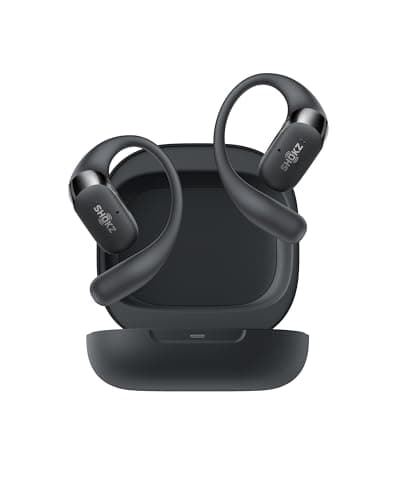
A silicone or titanium-cored hook loops over the top of your ear, the speaker module sits in front of the canal, and a counterweight behind the ear balances it. The hook is doing mechanical work, not frictional work, so sweat does not reduce its grip.
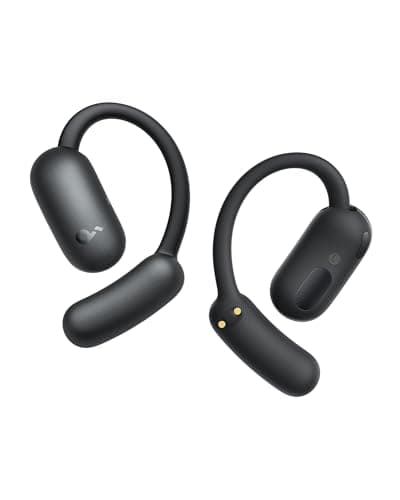
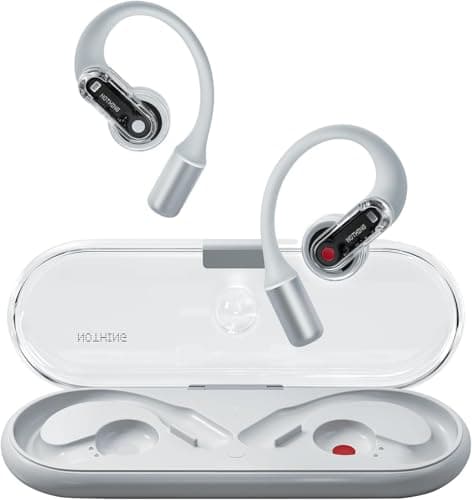
The hook's weakness is not slipping, it is fit variation: ears differ in how far the helix stands off the head, and a fixed hook that is slightly too open sits loose. Soundcore's answer is a four-position adjustable hinge on the AeroFit 2 and V20i, which is the single best feature in this category for anyone whose ears reject fixed hooks. SoundGuys reported no issues with the Nothing Ear (open) staying in place across gym and cycling sessions, which is the kind of specific finding worth more than a maker's claim.
3. Clip-on — the one with a reputation problem
A clip-on wraps the outer rim of your ear like a cuff, with the speaker in front of the canal and the battery barrel behind. It grips a thin edge of cartilage rather than the whole ear, which makes it the lightest and least intrusive of the three — and the one people do not trust.
SoundGuys' Sony LinkBuds Clip review captures it exactly: the fit was secure in use, but the tester felt they were “ready to fall out.” That is the clip-on experience. In practice they hold for walking, steady running, cycling and lifting. We would not pick them for sprints, box jumps or anything with a lot of head shake, and that is reflected in the scores. The hook-versus-clip decision is argued out in ear-hook vs clip-on.
What holds what
| Activity | Neckband | Ear-hook | Clip-on |
|---|---|---|---|
| Walking, hiking | Yes | Yes | Yes |
| Steady running | Yes | Yes | Usually |
| Sprints and intervals | Yes | Yes | Check first |
| Cycling under a helmet | Yes, band sits under straps | Yes | Yes, nothing over the ear |
| Lifting, bench and rack work | Band contacts a bench on back exercises | Yes | Yes |
| Burpees, box jumps, rope work | Yes | Yes | Not our pick |
| Wearing glasses | Shares the space behind the ear | Can collide with the arms | Best of the three |
| Wearing a hat or hood | Band can snag the hood | Yes | Yes |
| Swimming | Only purpose-built swim models | No | No |
Three things that do dislodge them
- A hook that is the wrong shape for your ear. Not the wrong size — the wrong angle. If the hook's arc is wider than the gap between your helix and your head, it rests loosely instead of gripping. The fix is an adjustable hook, not a tighter fit.
- Things you pull over your head. The commonest real-world loss is a hoodie, a race shirt or a helmet strap catching a bud or band on the way past. This is the one failure that affects all three designs, and the only fix is remembering.
- A neckband frame that is too large. If the band has play in it, every footstrike makes it bounce, and the transducers lose contact so the sound thins at the same time. Buy the Mini if your head circumference is under the published cutoff.
Note what is not on that list: sweat. Sweat kills sealed-earbud retention and it kills electronics, but it does not loosen a hook or a band. It does make the housing slippery when you go to take them off.
Feeling loose vs being loose
Worth separating, because the two have different answers. A sealed earbud that feels loose is loose: the seal is the fit, and if the bass has thinned the bud has moved.
An open-ear bud that feels loose is usually fine. There is no seal to report on, so your brain has no signal to read except weight and contact, and the lightest designs give the least of both. A 5.9 g Bose cuff or a 6.4 g Shokz clip-on genuinely feels like it could go at any moment and genuinely stays put. Give any clip-on one session of hard effort before you decide — if it is still on after a set of intervals, it was never going anywhere.
How to fix a pair that moves
- Hooks: move to an adjustable-hinge model (Soundcore AeroFit 2, V20i) or drop to a lighter bud so there is less mass for the hook to control. The OpenFit Air 2 is 7.2 g against the OpenFit 2's 9.4 g.
- Clip-ons: check the cushion sizes. Baseus ships detachable air cushions in M, L and XL and Sony sells silicone stability accessories; a half-size change in the pad is often the whole fix.
- Neckbands: re-check the frame size against your head circumference before anything else. If the band bounces, you bought the wrong one, and no technique compensates.
- All three: set the bud or band first and your glasses, hat or helmet second. Doing it the other way round is how most mid-session shifts start.
If you want the techniques that work on sealed earbuds instead, they are collected in how to keep earbuds from falling out.
Picks
Our picks for this
One of each, in order of how certain the hold is
The neckband that cannot come off, the reference ear-hook, the adjustable hook for ears that reject fixed ones, and the lightest hook with controls that work when your fingers are wet.
Best for heavy sweaters
Shokz OpenRun Air 2
Bone conduction (neckband)8.7/10Retention by skull, not by ear: nothing to dislodge, IP67, 26.4 g, two frame sizes.
$129.95Amazon#ad · Price as of October 11, 2026 · Disclosure for the link to Shokz OpenRun Air 2
Best open-ear earbuds overall
Shokz OpenFit 2
Open-ear hook8.3/10The ear-hook benchmark: 11 hours, IP55 buds, and a physical button that a wet finger cannot misfire.
$179.95Amazon#ad · Price as of October 11, 2026 · Disclosure for the link to Shokz OpenFit 2
Best adjustable fit
Soundcore AeroFit 2
Open-ear hook8.4/10A four-position adjustable hinge, which is the real fix if fixed hooks sit loose on your ears.
$79.99Amazon#ad · Price as of October 11, 2026 · Disclosure for the link to Soundcore AeroFit 2
Best for pinch controls
Nothing Ear (open)
Open-ear hook7.7/108.1 g with pinch controls; SoundGuys reported no stability issues across gym and cycling use.
$84.00Amazon#ad · Price as of October 11, 2026 · Disclosure for the link to Nothing Ear (open)
How we scored this
The research behind every pick
Each pair on this page is researched and compared the same way: we classify the retention system that holds it on (hook, clip, wing, neckband), read the maker's published IP rating, weight, battery, charging, mic and control type straight off its own product page and manual, check the sweat and water rating against the IEC 60529 standard, cross-reference independent published reviews, and score every pick on a public rubric. Every figure links to the document it came from, so you can check any number in one click.
Prices come live from Amazon, so what you see is what you pay today. Commissions never set a score or decide a pick. The rubric and its weights are published.
Questions
Frequently asked
Do open-ear earbuds fall out when running?
Are clip-on earbuds secure enough for the gym?
Which open-ear design is the most secure?
Do open-ear earbuds work with glasses?
Why do my open-ear hooks feel like they are slipping?
Keep reading
Related on Openear Club
Receipts
Sources
- Shokz — official product comparison table (checked 2026-09-21)
- Shokz — In-Ear, Semi-In-Ear and Open-Ear Headphones Explained, NIKI Jane, April 7, 2026 (checked 2026-09-24)
- Shokz — OpenRun vs. OpenRun Mini: find your perfect fit (checked 2026-09-26)
- SoundGuys — Nothing Ear (open) review (checked 2026-09-21)
- SoundGuys — Sony LinkBuds Clip review (checked 2026-09-21)
- Soundcore — AeroFit 2 product page (checked 2026-09-21)
- Baseus — Bowie MC2 product page, specifications (checked 2026-09-21)
Every spec here is traceable: figures come from the maker's own product pages and are linked on each product, independent findings are attributed to whoever published them, and prices come live from Amazon so the number you see is the number you pay today. Read the full method.