Bone Conduction · Guide
Bone conduction headphones vs earbuds: one cannot fall out, the other has bass
A bone conduction neckband hangs off your skull and leaves the canal empty. An earbud sits inside the canal and seals it. Everything people argue about downstream - bass, leakage, sweat, safety - follows from those two sentences.
By Mike M.Updated Spec-checked, not worn by us
#adReader-supported: we may earn a commission if you buy through our links, at no extra cost to you. It never decides a ranking. How we rank · Disclosure
What each one actually is
Bone conduction headphones are a single piece: a titanium or alloy band that wraps behind your head, ear hooks that rest on top of your ears, and two transducers that press against the bone in front of the ear canal. Nothing enters the ear. Shokz describes the mechanism as vibrations “transmitted through the skin and temporal bone to the cochlea, bypassing traditional air conduction transmitters like the external auditory canal or eardrum.”
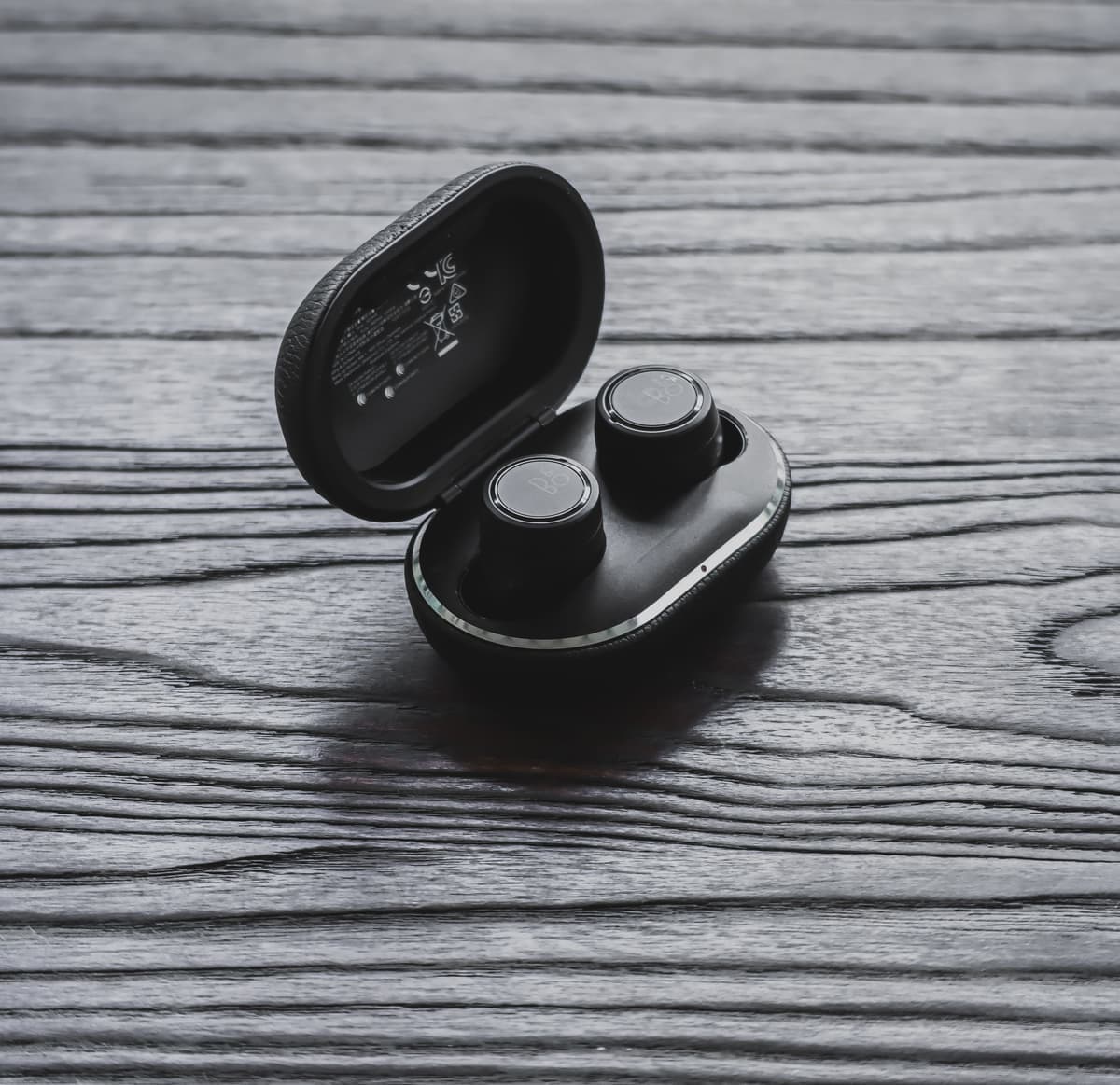
Earbuds, in the sense the question is usually asked, means sealed true-wireless earbuds: two separate pods, each with a silicone tip that plugs the canal, and a charging case. The driver moves air, the air moves your eardrum, three small bones pass it along. Some sport models add an ear hook or a wingtip on the outside to stop them working loose; the tip is still what seals.
There is a third family that gets lumped in with both and belongs to neither: open-ear air-conduction earbuds, which hang a speaker in front of an open canal without touching it. If what you actually want is “no tip in my ear, but better sound than bone conduction,” that is the family to read about, at open-ear vs bone conduction.
Side by side
| Factor | Bone conduction neckband | Sealed earbuds |
|---|---|---|
| What holds it on | The band around your skull | Friction of a silicone tip, plus a hook or wing if fitted |
| In the ear canal | Nothing | A tip, sealed |
| Bass | Thin; sub-bass essentially absent | Full, because the seal gives the driver something to push against |
| Isolation | None by design | Passive seal, plus ANC on most sport models |
| Ratings on this site | IP55 to IP68, including swim models | IPX4 to immersion-rated |
| Case | None; it folds and goes round your neck | Required, and the case is often the weakest-rated part |
| Battery per charge | 6 to 13 hours | 7 to 12 hours per bud, plus 20 to 48 in the case |
| Losing one | Impossible; it is one object | The classic failure: one bud, one drain, one gutter |
| Lying down | The band presses on a pillow or a bench | A tip is flatter, though still not comfortable |
| Glasses and hats | The band shares the space behind your ears | Nothing outside the ear unless it has a hook |
Fit: the reason most people switch
A sealed earbud stays in because a rubber tip grips the walls of your canal. Add sweat and that grip drops. Add an impact - a foot strike, a rep, a jaw movement while chewing gum - and the bud creeps out by a millimeter, the seal breaks, the bass disappears, and you push it back in. That loop is the single most common reason people arrive at this site; we wrote the fix-it version at how to keep earbuds from falling out.
Bone conduction removes the loop rather than improving it. The transducers are held against your cheekbones by band tension, so there is no seal to break and no tip to slip. It is the most secure fit on this site, which is why our rubric scores the Shokz OpenRun models 10 out of 10 for fit security. The cost is that the band is now part of your outfit: it shares the space behind your ears with glasses arms and hat brims, and it presses against a bench or a pillow when you lie down.
Sound: the reason most people switch back
This is not close. A sealed earbud works against a closed pocket of air, which is how a 10 mm driver produces bass you feel. Bone conduction has to vibrate your skull instead, and bone transmits mids and highs far better than lows: producing real bass would mean shaking your head hard enough to feel it. SoundGuys puts the category verdict bluntly - bone conduction headphones “don't sound as good as a pair of the best headphones on the market will” because “sub-bass and bass are virtually inaudible.”
Two things narrow the gap without closing it. The Shokz DualPitch system pairs each bone transducer with a small air-conduction driver, which is why the OpenRun Pro 2 is the best-sounding neckband we rank. And content matters: podcasts, audiobooks, radio and most vocal-led music survive the trip through bone perfectly well. Bass-forward music does not. The honest long answer is at do bone conduction headphones sound good?
There is also a comfort quirk with no earbud equivalent: at high volume the transducers become a physical tickle on the temple. Turning it down fixes it, which is a nudge in the right direction anyway.
Sweat, water and what survives
| Evidence | Shokz OpenRun Air 2 | Soundcore Sport X20 | Beats Powerbeats Pro 2 |
|---|---|---|---|
| Fit system | Bone conduction (neckband) | In-ear + ear hook | In-ear + ear hook |
| Water & sweat rating | IP67 (dust-tight, temporary immersion); Shokz: not for swimming | Soundcore lists IP68 in its product imagery and IPX7 in its product description; both are immersion ratings | IPX4 |
| Weight | 26.4 g standard / 25.9 g mini | — | 8.7 g per earbud; case 69 g |
| Battery | 10 hours listening | 12 hours per charge / 48 with case (normal); 7 / 28 with ANC | Up to 10 hours per bud; up to 45 hours with case |
| Controls | Physical buttons | Physical buttons, customizable in the app | Multi-function button and volume rocker on each side |
| Score | 8.7/10 | 8.9/10 | 8.1/10 |
A bone conduction neckband is a single sealed object with no hinge, no lid and no case, which is why the strongest ratings on this site live in that category: IP67 on the Shokz OpenRun and OpenRun Air 2, IP68 on the Mojawa Run Plus and the Raycon, IPX8 on the Creative Outlier Free Pro, and genuine swim models with onboard storage. The Shokz comparison table calls the OpenRun fully washable under the tap.
Sealed earbuds are a mixed bag, and the case is usually the weak link. The Powerbeats Pro 2 is IPX4 - a splash rating - and its case is unrated. The Soundcore Sport X20 is immersion-rated. The Apple AirPods Pro 3 rate both buds and case at IP57. The number on the box is what matters here, not the price; see IPX4 vs IPX5 vs IPX7.
Hearing the room
With bone conduction your ear canal is empty, so traffic, a bike bell, a spotter or a crossing signal arrives exactly as it would with nothing on your head. No processing, no transparency mode, no battery cost. With sealed earbuds the canal is plugged and that information is gone unless a microphone and a chip feed it back to you, which good ANC earbuds do well and cheap ones do badly.
Neither is safer for your hearing. Both paths end at the same hair cells, and NIDCD is clear that “long or repeated exposure to sounds at or above 85 dBA can cause hearing loss” however the energy arrives. What changes is the incentive: a sealed bud that blocks the gym lets you listen quietly, while an open ear tempts you to turn it up over the noise. The full discussion is at are bone conduction headphones safe?
The verdict
Picks
Our picks for this
Two neckbands, two sealed sport buds
The bone conduction pair we rank highest, and the two sealed earbuds that answer the fit problem with hardware rather than a tip.
 Stock photo
Best bone conduction overall
Shokz OpenRun Pro 2
Bone conduction (neckband)8.5/10The best-sounding bone conduction: DualPitch adds an air driver for the low end.
Check price · Amazon#ad · Price set by Amazon · Disclosure for the link to Shokz OpenRun Pro 2
- Stock photo
Best for heavy sweaters
Shokz OpenRun Air 2
Bone conduction (neckband)8.7/10IP67, 26.4 g, Bluetooth 6.0: the one to rinse under the tap after a soaked session.
Check price · Amazon#ad · Price set by Amazon · Disclosure for the link to Shokz OpenRun Air 2
 Stock photo
Best sweatproof in-ear
Soundcore Sport X20
In-ear + ear hook8.9/10Sealed and immersion-rated, with hooks that rotate and extend to fit your ear.
Check price · Amazon#ad · Price set by Amazon · Disclosure for the link to Soundcore Sport X20
- Stock photo
Best in-ear hook for lifting
Beats Powerbeats Pro 2
In-ear + ear hook8.1/10Nickel-titanium hooks, ANC and heart-rate sensing; IPX4 is the caveat.
Check price · Amazon#ad · Price set by Amazon · Disclosure for the link to Beats Powerbeats Pro 2
How we scored this
Pairs we claim to have worn: none we haven't
Plenty of sites say they ran a hundred miles in every pair on the list. We don't say that, and we say so on every page. What we do instead: classify the retention system (hook, clip, wing, neckband), record the maker's published IP rating, weight, battery, charging, mic and control type from its own product page, cross-reference at least one independent published review where one exists, and score every pick on a public rubric. Every figure links to where it came from.
Scores are editorial judgments from that documented research, not lab results. Commissions never set a score or decide a pick. The rubric and its weights are published.
Questions
Frequently asked
Are bone conduction headphones better than earbuds?
Do bone conduction headphones sound worse than earbuds?
Can bone conduction headphones fall off?
Which is better for the gym, bone conduction or earbuds?
Keep reading
Related on Openear Club
- Open-ear vs bone conductionThe other open-ear family, and how it differs.
- Open-ear vs in-ear earbudsThe same argument without the neckband.
- Best bone conduction headphonesThe ranking, if the verdict points you here.
- Earbuds that do not fall outSealed picks with real mechanical retention.
- Do bone conduction headphones sound good?The sound gap in detail.
Receipts
Sources
- Shokz — bone conduction technology page (checked 2026-09-21)
- Shokz — official product comparison table (checked 2026-09-21)
- SoundGuys — Best bone conduction headphones, Chase Bernath, updated Jan 23, 2026 (checked 2026-09-21)
- Occlusion effect — definition and low-frequency mechanism, Wikipedia (checked 2026-09-24)
- NIDCD (NIH) — Noise-Induced Hearing Loss (checked 2026-09-21)
- Soundcore — Sport X20 product page (checked 2026-09-21)
- Beats — Powerbeats Pro 2 product page, tech specs (checked 2026-09-21)
- IEC 60529 (IP Code) — degree-of-protection definitions, Keystone Compliance summary (checked 2026-09-21)
We haven't worn every pair on this site and we don't pretend to. Specs come from the maker's own product pages (linked on every product), independent findings are attributed to whoever published them, and Amazon prices change often, so we don't print them. Where a figure isn't published, we say so. Read the full method.