Open-Ear Earbuds · Guide
Open-ear vs in-ear earbuds: what you give up, what you get back, and which to buy
The question isn't which sounds better. It's whether the thing that's failing you is the seal. Here's how to tell, and what to buy on each side of the line.
By Mike M.Updated Spec-checked, not worn by us
#adReader-supported: we may earn a commission if you buy through our links, at no extra cost to you. It never decides a ranking. How we rank · Disclosure
The 60-second definition
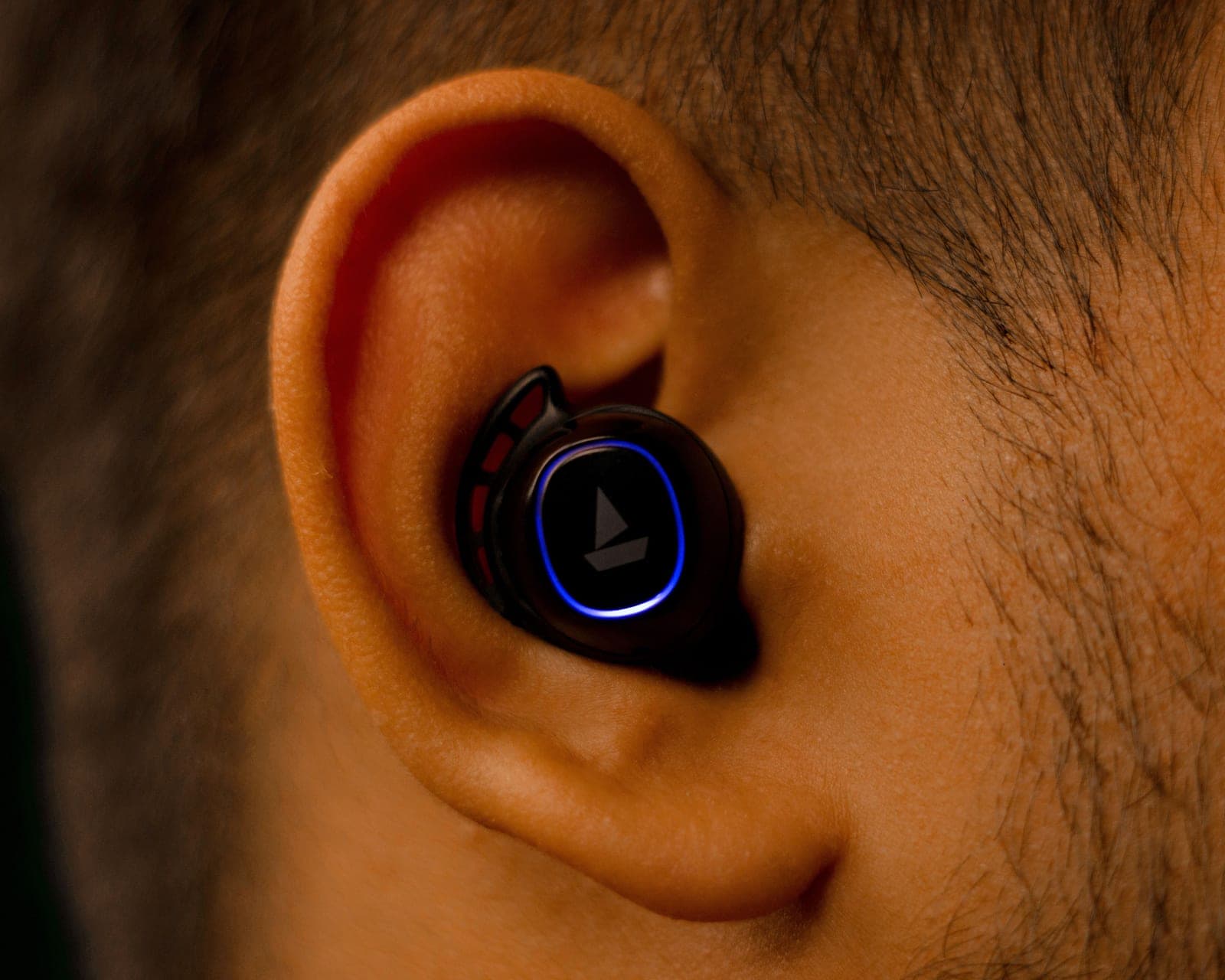
In-ear earbuds put a silicone tip into the ear canal and rely on the seal for two things: bass (a sealed canal lets a tiny driver move air against your eardrum) and staying in (friction). Sport versions add a hook or a wingtip because friction alone fails when you sweat.
Open-ear earbuds don't enter the canal. Air-conduction versions (ear-hooks and clip-ons) hang a small speaker just outside it. Bone conduction versions skip the canal entirely and vibrate the cheekbone from a neckband. All three leave you hearing the room at normal volume, and none of them can fall out of a canal they were never in.
Side by side
| Factor | Open-ear (hook / clip / neckband) | In-ear (tip, with hook or wing) |
|---|---|---|
| Stays in during sweat | Yes; retention doesn't depend on the canal | Depends on hook or wing; plain tips slip |
| Hear traffic / a spotter | Yes, at natural volume | No unless transparency mode is on |
| Bass | Limited; no seal to work against | Full |
| Isolation from a loud gym | None (the Soundcore AeroFit 2 Pro and Shokz OpenFit Pro offer partial reduction) | Passive seal plus ANC on most sport models |
| Leakage to people nearby | Some, always | Minimal |
| Ear fatigue / pressure | None in the canal; some weight on the ear | Canal pressure and occlusion on long sessions |
| Typical water ratings | IP54 to IP68 | IPX4 to IP68 |
| Glasses | Clip-ons and neckbands fine; hooks compete for space | Wings fine; hooks compete |
Fit: why in-ears fall out and open-ears don't
A sealed tip stays in by friction against the canal wall. Sweat lubricates that wall. Jaw movement (talking, breathing hard, chewing gum) reshapes the canal a little with every rep. So the earbud creeps, and at some point it drops. Sport in-ears fix this with a hook over the ear or a wing in the concha, which is why the ones we list on earbuds that don't fall out all have one or the other.
An open-ear never used the canal, so there's nothing for sweat to lubricate. A hook or a neckband is held by the shape of the ear or the head; a clip is held by spring tension on the rim. On our rubric a neckband scores 10 for fit security, a hook 9, a clip 8, and a sealed hook 9 to 10; a plain in-ear with no hook or wing isn't on this site at all.
Awareness and safety
This is the reason open-ear exists. On a road shoulder, a bike lane or a shared trail, hearing the car, the bell or the footsteps behind you is not a feature, it's the difference between a headphone you can use there and one you can't. Transparency modes on in-ears pipe the outside world through a microphone; they work, but they add latency and a processed quality, and they drop out when the battery is prioritized for ANC. The safety case, with the caveats, is in can you hear traffic with open-ear headphones.
Sound, bass and leakage
Bass needs a sealed volume of air. Open-ears don't have one, so makers compensate with bigger drivers, dual drivers (Shokz DualBoost, SuperBoost) and clever aiming (DirectPitch). It helps; it doesn't match a sealed earbud. The same open path lets some sound out, so the person next to you on a quiet train hears a thin version of your music. If most of your listening is in quiet shared rooms, read open-ear sound leakage before you commit.
Sweat and water
Neither design is inherently more sweatproof; the rating is. Bone conduction neckbands tend to carry the highest ratings (IP55 to IP68) because a sealed neckband is easier to build than a hinged cuff. Ear-hooks cluster at IP55. Clip-ons were IPX4 until 2026 and now reach IP57 and IP67. Sealed sport in-ears run from IPX4 (Beats) to IP68 (Soundcore Sport X20). Read the digits before the design: IPX4 vs IPX5 vs IPX7.
How to decide
- Open-ear if you run or ride outdoors, if plain in-ears slip, if a seal gives you sore ears or a plugged feeling, or if you want to hear a training partner.
- In-ear with a hook or wing if you train in a loud gym and want isolation, if bass is non-negotiable, or if you want ANC for a treadmill or a flight.
- Bone conduction if fit and water rating matter more than sound: see open-ear vs bone conduction for that fork.
Picks for each side
Our picks for this
Two open-ears, two sealed sport buds
Chosen from the registry for this decision: the ear-hook and clip-on we rank highest, and the two sealed hooks with the best fit story.
 Stock photo
Best open-ear earbuds overall
Shokz OpenFit 2
Open-ear hook8.3/10The open-ear default: hook, IP55, 11 hours, a button.
Check price · Amazon#ad · Price set by Amazon · Disclosure for the link to Shokz OpenFit 2
 Stock photo
Best clip-on for sweat
Shokz OpenDots 2
Open-ear clip-on8.6/10The open-ear for glasses and helmets: IP57 clip, 10 hours.
Check price · Amazon#ad · Price set by Amazon · Disclosure for the link to Shokz OpenDots 2
 Stock photo
Best sweatproof in-ear
Soundcore Sport X20
In-ear + ear hook8.9/10Sealed, adjustable hooks, ANC, immersion-rated: the in-ear that stays put and survives.
Check price · Amazon#ad · Price set by Amazon · Disclosure for the link to Soundcore Sport X20
- Stock photo
Best in-ear hook for lifting
Beats Powerbeats Pro 2
In-ear + ear hook8.1/10Sealed, reinforced hooks, ANC, heart rate; IPX4 is the caveat.
Check price · Amazon#ad · Price set by Amazon · Disclosure for the link to Beats Powerbeats Pro 2
How we scored this
Pairs we claim to have worn: none we haven't
Plenty of sites say they ran a hundred miles in every pair on the list. We don't say that, and we say so on every page. What we do instead: classify the retention system (hook, clip, wing, neckband), record the maker's published IP rating, weight, battery, charging, mic and control type from its own product page, cross-reference at least one independent published review where one exists, and score every pick on a public rubric. Every figure links to where it came from.
Scores are editorial judgments from that documented research, not lab results. Commissions never set a score or decide a pick. The rubric and its weights are published.
Questions
Frequently asked
Are open-ear earbuds better than in-ear?
Do open-ear earbuds sound worse?
Can in-ear earbuds be safe for running near traffic?
Which is better for glasses?
Keep reading
Related on Openear Club
Receipts
Sources
- Shokz — official product comparison table (checked 2026-09-21)
- Soundcore — Sport X20 product page (checked 2026-09-21)
- Beats — Powerbeats Pro 2 product page, tech specs (checked 2026-09-21)
- IEC 60529 (IP Code) — degree-of-protection definitions, Keystone Compliance summary (checked 2026-09-21)
- Shokz — bone conduction technology page (checked 2026-09-21)
We haven't worn every pair on this site and we don't pretend to. Specs come from the maker's own product pages (linked on every product), independent findings are attributed to whoever published them, and Amazon prices change often, so we don't print them. Where a figure isn't published, we say so. Read the full method.