Bone Conduction · Guide
Are bone conduction headphones worth it? Only for one specific job, and they are the best thing at it
Bone conduction is not a better headphone. It is a different trade: you give up bass and isolation permanently, and in exchange nothing touches your ear canal and nothing can fall out of it. Whether that is worth money depends entirely on which of those two sentences describes your problem.
By Mike M.Updated Researched · every spec sourced
#adReader-supported: we may earn a commission if you buy through our links, at no extra cost to you. It never decides a ranking. How we rank · Disclosure
The short version
Who they are worth it for
- Anyone whose earbuds fall out. This is the biggest group and the clearest yes. A bone conduction set has nothing in the ear canal at all — retention comes from a sprung titanium band around the back of your skull. There is no tip to loosen, no seal to break, nothing to re-seat mid-set. On our rubric every neckband we rank scores a 10 for fit security, and that is not grade inflation: there is no mechanism by which they come off.
- Heavy sweaters. The category has the strongest water ratings on this site because a neckband is a single sealed object with no lid, no hinge and no charging case to get wet: IP67 on the OpenRun and OpenRun Air 2, IPX8 on the Creative Outlier Free Pro, IP68 on the Mojawa Run Plus. Sealed earbuds with cases often top out at IPX4.
- Road runners and cyclists. The ear canal stays completely open, so traffic, a bell behind you or a shout arrives unprocessed, with no microphone, no latency and no battery cost. No transparency mode matches it because there is nothing to be transparent through. The case is made in can you hear traffic with open-ear headphones?
- Glasses wearers whose ear-hooks collide. Not universally — a neckband shares the space behind your ears too — but it sits lower and thinner than a hook. What actually works is in bone conduction headphones with glasses.
- People who take calls while moving. No occlusion effect, because nothing seals the canal, so your own voice does not boom. The OpenComm2 UC adds an actual boom microphone and 16 hours of talk time.
- Anyone who gets ear pain from tips. Nothing enters the canal, so no pressure and no moisture trap. If that is your issue, start at why do my earbuds hurt my ears?
Who they are not worth it for
- Anyone buying for sound quality. Bone conduction transmits mids and highs adequately and lows badly, because producing real bass would mean vibrating your skull hard enough to feel it as a buzz rather than hear it as music. SoundGuys puts the category limit plainly: sub-bass and bass are “virtually inaudible.” The Shokz DualPitch system on the OpenRun Pro 2 adds an air driver and narrows the gap without closing it.
- Flights, trains and open-plan offices. There is no isolation by design, and there is leakage going out: the person next to you hears a thin version of your podcast. If you need a quiet bubble, this is the wrong category and no model in it is the exception.
- Swimmers buying a general-purpose pair. Only purpose-built models with onboard storage work in water, because Bluetooth does not travel through it. Shokz prints “not for swimming” next to the OpenRun Air 2's IP67. The pool-specific set is ranked in best bone conduction headphones for swimming.
- Competitive gaming. No positional low end and Bluetooth latency. Covered, with the one exception, in bone conduction for gaming.
- Anyone hoping for a hearing-safety upgrade. Bypassing the eardrum does not bypass the cochlea, and NIDCD's 85 dBA guidance applies unchanged. See do bone conduction headphones cause hearing loss?
Is the expensive one worth it?
Separate question from “is the category worth it,” and the answer is more interesting, because the price spread in this category buys unusually specific things.
Under $100 gets you the real feature set. The Creative Outlier Free Pro is IPX8 with 10 hours and 8 GB of storage; the Shokz OpenMove is IP55 with 6 hours and USB-C. What you give up is quick charge, the newest radio and sound refinement — not fit security and not the open ear, which are the two reasons to buy the category at all. For a first pair, this band is genuinely enough.
Mid-range is where the OpenRun Air 2 sits, and it is the best-value point on the whole site for this category: IP67, 26.4 g, 10 hours, Bluetooth 6.0, quick charge, two frame sizes.
The top — the OpenRun Pro 2 — buys you exactly two things: DualPitch sound and 12 hours. If thin audio is the complaint that would make you stop wearing them, that is worth paying for. If it is not, the money is better spent elsewhere. The three-way is laid out in OpenRun Air 2 vs OpenRun Pro 2.
Four questions that settle it
- In the last six months, have your earbuds fallen out or died from sweat? If yes, stop reading and buy a neckband. That is the problem this category was built to solve and it solves it completely.
- Do you listen to music or to talking? Podcasts, audiobooks, radio and coaching apps lose almost nothing to bone conduction. Music with a bass line loses a lot. Be honest about your actual listening, not your aspirational listening.
- Where will you wear them most — outdoors, or in a quiet room with other people? Outdoors is a yes. A shared quiet room is a no, because of leakage out, not sound in.
- Would you also keep a sealed pair? If yes, buy the mid-range neckband and spend nothing more. If this has to be your only headphone, consider an open-ear ear-hook instead — see below.
What to look for if the answer is yes
Four specs, in this order, and nothing else is close:
- Frame size options. A neckband has no fit adjustment: either the arc matches your head or it bounces or aches. Shokz publishes a 9.25-inch head-circumference cutoff between Standard and Mini. A one-size-only pair is a gamble, which is the core of Shokz vs Raycon.
- The water rating, read properly. IP55 covers sweat and rain; IP67 and above means you can rinse the salt off under a tap, which is the maintenance habit that doubles the life of a sweaty pair. The digits are decoded in earbud IP ratings explained.
- Quick charge, not total battery. Every current Shokz turns 5 to 10 minutes into 1.5 to 2.5 hours. That saves the session you forgot about; three extra hours of total runtime does not.
- Buttons over touch panels. A wet fingertip on a capacitive panel skips tracks you did not want to skip. Every Shokz neckband uses physical buttons.
Picks
Our picks for this
One at each price, plus the pair to buy instead
Three neckbands covering the budget, mid and top of the category, and the open-ear ear-hook to buy if this has to be your only pair of headphones.
Best for heavy sweaters
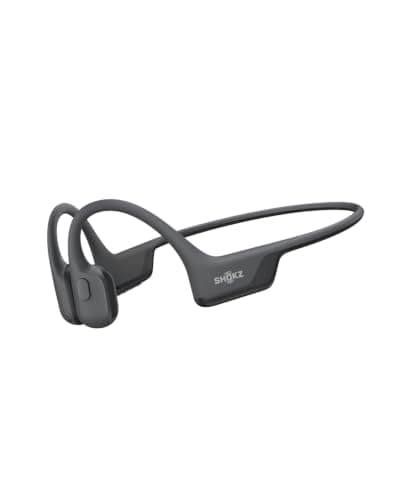
Shokz OpenRun Air 2
Bone conduction (neckband)8.7/10The value answer for this category: IP67, 26.4 g, 10 hours, Bluetooth 6.0, two frame sizes.
$129.95Amazon#ad · Price as of October 11, 2026 · Disclosure for the link to Shokz OpenRun Air 2
Best bone conduction overall
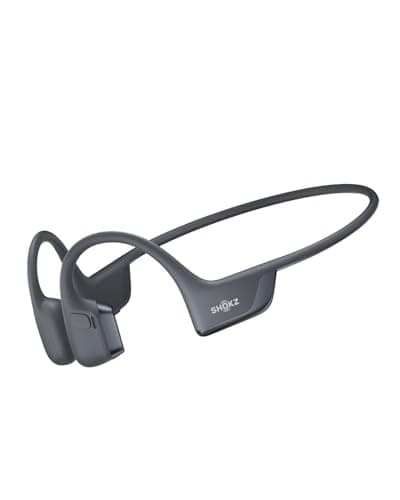
Shokz OpenRun Pro 2
Bone conduction (neckband)8.5/10Worth the premium only for the DualPitch air driver and 12 hours; IP55, so no tap rinse.
$179.95Amazon#ad · Price as of October 11, 2026 · Disclosure for the link to Shokz OpenRun Pro 2
Best bone conduction under $100
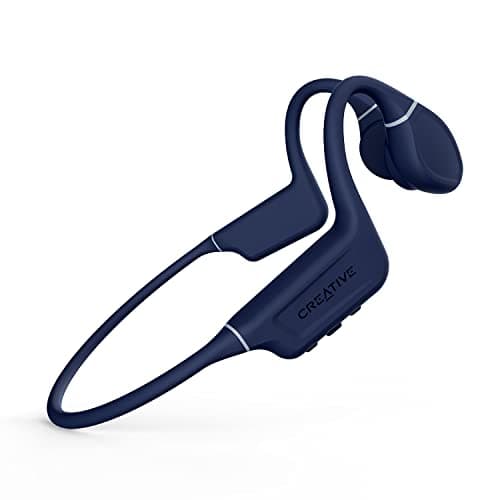
Creative Outlier Free Pro
Bone conduction (neckband)8.3/10Proof the category works on a budget: IPX8, 10 hours and 8 GB of onboard storage for well under $100.
$59.99Amazon#ad · Price as of October 11, 2026 · Disclosure for the link to Creative Outlier Free Pro
Best open-ear earbuds overall
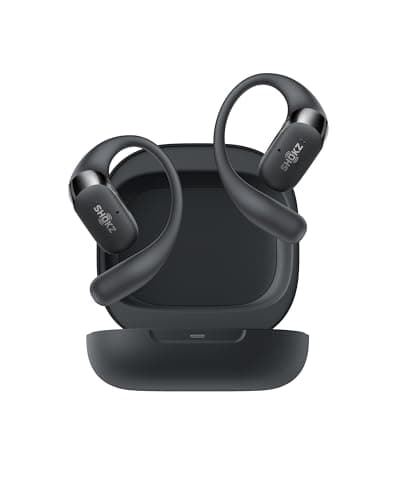
Shokz OpenFit 2
Open-ear hook8.3/10Not bone conduction: an open-ear hook. Same open canal, considerably better sound, IP55 buds, 11 hours.
$179.95Amazon#ad · Price as of October 11, 2026 · Disclosure for the link to Shokz OpenFit 2
The alternative most people should consider first
If you want the open ear but the sound quality is what is making you hesitate, the answer is probably not a neckband at all — it is an open-ear ear-hook. These are air-conduction earbuds with the speaker sitting just in front of the canal and a silicone hook over the ear: the canal stays open, you still hear traffic, nothing goes inside your ear, and the sound is considerably fuller because it is a conventional driver moving air rather than a plate vibrating bone.
The Shokz OpenFit 2 is the reference there — 11 hours, IP55 buds, a physical button plus touch, dual drivers. The trade-offs are a case that carries no water rating, a hook that can fight glasses, and slightly less absolute certainty than a band around your whole head. Which way to go is argued out in open-ear vs bone conduction, and the hooks are ranked in best open-ear earbuds.
How we scored this
The research behind every pick
Each pair on this page is researched and compared the same way: we classify the retention system that holds it on (hook, clip, wing, neckband), read the maker's published IP rating, weight, battery, charging, mic and control type straight off its own product page and manual, check the sweat and water rating against the IEC 60529 standard, cross-reference independent published reviews, and score every pick on a public rubric. Every figure links to the document it came from, so you can check any number in one click.
Prices come live from Amazon, so what you see is what you pay today. Commissions never set a score or decide a pick. The rubric and its weights are published.
Questions
Frequently asked
Are bone conduction headphones worth it for running?
Are cheap bone conduction headphones worth it?
Do bone conduction headphones sound bad?
Is bone conduction worth it over an open-ear ear-hook?
Are bone conduction headphones worth it for the gym?
Keep reading
Related on Openear Club
Receipts
Sources
- Shokz — official product comparison table (checked 2026-09-21)
- Shokz — bone conduction technology page (checked 2026-09-21)
- Shokz — OpenRun vs. OpenRun Mini: find your perfect fit (checked 2026-09-26)
- SoundGuys — Best bone conduction headphones, Chase Bernath, updated Jan 23, 2026 (checked 2026-09-21)
- Creative — Outlier Free Pro product page, specifications (checked 2026-09-21)
- NIDCD (NIH) — Noise-Induced Hearing Loss (checked 2026-09-21)
- Occlusion effect — definition and low-frequency mechanism, Wikipedia (checked 2026-09-24)
- IEC 60529 (IP Code) — degree-of-protection definitions, Keystone Compliance summary (checked 2026-09-21)
Every spec here is traceable: figures come from the maker's own product pages and are linked on each product, independent findings are attributed to whoever published them, and prices come live from Amazon so the number you see is the number you pay today. Read the full method.