Open-Ear Earbuds · Guide
Do open-ear earbuds have noise cancellation?
Three unrelated features are printed as noise cancelling on open-ear packaging, and only one of them quiets the room you are standing in. Here is how to tell which one a listing means before you pay for it.
By Mike M.Updated Researched · every spec sourced
#adReader-supported: we may earn a commission if you buy through our links, at no extra cost to you. It never decides a ranking. How we rank · Disclosure
The direct answer
Why ANC needs a seal
Active noise cancellation is destructive interference. A microphone measures the noise arriving at your ear, the chip computes an inverted waveform, and a driver plays it so the two sum to something close to silence at your eardrum.
Three conditions have to hold for that to work, and all three depend on a sealed canal:
- The cancelling sound has to reach your eardrum along the same path as the noise. With a sealed tip, the only path into the canal is the driver, so the sum is controlled. With an open canal, noise also arrives directly around the earbud, on a path the system is not driving.
- The volume between the driver and the eardrum has to be small and fixed. A sealed canal is a small, closed chamber. An open canal is a tube that opens to a room, and the acoustic conditions change every time you move your head.
- Passive attenuation has to handle the high frequencies. ANC is only effective at low frequencies in practice; the silicone tip itself blocks the highs. Remove the tip and you remove the half of the system that was doing the easy work.
So an open-ear earbud cannot cancel the room by design, not by cost-cutting. This is the same physical story that limits open-ear bass, for the same reason: no seal, no pressure chamber. Both halves are in open-ear vs in-ear earbuds.
The three things called noise cancelling
1. Microphone noise cancelling (almost every open-ear product). Shokz's “dual AI noise-canceling” mics, JLab's ENC, Soundcore's four-mic AI arrays, Bose's SpeechClarity. These process the outgoing signal so the person on your call hears your voice rather than the street. They are genuinely useful and they do nothing at all for what you hear. This is what the overwhelming majority of “noise cancelling” claims on open-ear boxes refer to. The ranking that treats this properly is best open-ear earbuds for phone calls.
2. Listener-side noise reduction (rare). Processing applied to the audio you are hearing, so that music stays intelligible against a noisy background without you raising the volume. It does not quieten the room; it changes the mix. Shokz calls its version Open-Ear Noise Reduction and it is on the OpenFit Pro.
3. True ANC (requires a seal, so requires a product that stops being open-ear). The only way to get this is for the earbud to close your canal. One product on this site does it mechanically, on demand, and it is below.
The two genuine exceptions
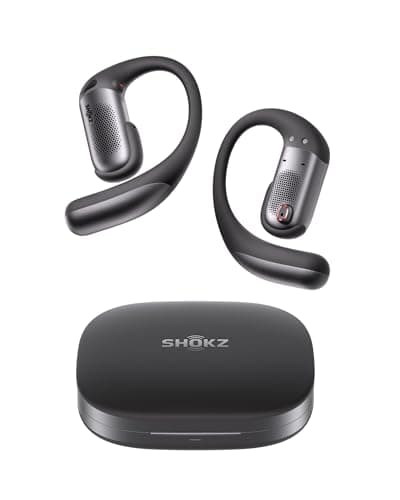
The Shokz OpenFit Pro. Shokz's flagship hook carries an open-ear noise reduction mode and is honest about its price: Shokz publishes 12 hours of battery with the mode off and 6 hours with it on. Halving the battery is the tell that real DSP is running rather than a marketing switch. What it does is make audio hold up in a noisy room; what it does not do is make the room quiet, and it cannot, for the reasons above. The detail is in the OpenFit Pro review.
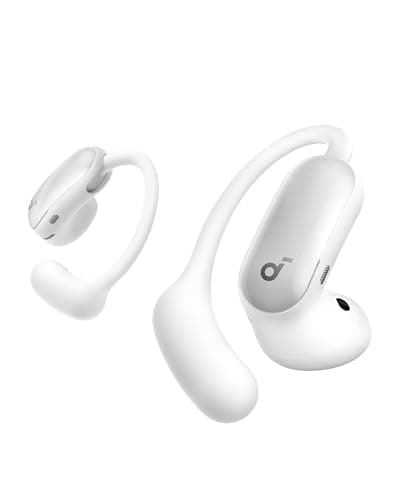
The Soundcore AeroFit 2 Pro. This is the only product in the category that answers the question in hardware. Its hook has four levels, and at one of them the driver swings into the canal and seals it, at which point genuine active noise cancelling becomes possible. Swing it back out and it behaves like any other air-conduction hook. The costs are plain on Soundcore's own spec sheet: 7 hours in open form against 5 hours in ANC form, 10.4 g per side, and one more moving part. And while it is sealed, the awareness that made you want open-ear in the first place is gone.
Both are ranked against each other, and against the models that only cancel on the microphone, in best open-ear earbuds with noise canceling.
How to read a listing
Four checks, in order, that take about thirty seconds:
- Look for the word “mic” or “call” next to the claim. “AI noise-cancelling microphones,” “ENC,” “clear calls” — that is category one. It is about your outgoing voice.
- Look for a battery figure with the feature on and off. Real listener-side processing costs power. If the maker publishes one number only, nothing is being computed for your ears.
- Look for a sealing mechanism. If the product cannot close your canal, it cannot do true ANC, whatever the headline says.
- Be suspicious of “ANC” with no mechanism named. On an open-ear listing with no hinge and no published cost, it is almost always category one relabelled.
What to buy instead, by situation
You want quiet on a plane or a commute. Buy a sealed earbud with real ANC and stop looking at open-ear. The sport-usable options with strong ratings are in best sweatproof earbuds; the budget one on this page is the JLab Epic Sport ANC 3 at IP66.
Your gym is loud but you want to hear the floor. This is the OpenFit Pro's case, or accept the room. The isolation-versus-awareness argument for a shared gym floor is in best earbuds for lifting and earbuds vs headphones for lifting.
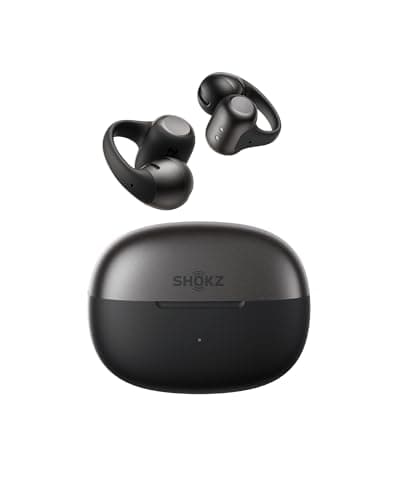
You take calls outdoors. You want category one, and the best version of it is not ANC at all — it is a bone-conduction microphone that reads your voice through your jaw, where there is no wind. The Shokz OpenDots 2 has one. See wind noise on open-ear earbuds.
You share an office and want privacy, not quiet. That is the leakage problem rather than the cancelling problem, and it has different answers — see open-ear earbuds sound leakage and best open-ear earbuds for work.
One safety note, because it follows directly from all of this. An open-ear earbud does not block ambient noise, which means the natural response in a loud place is to turn the volume up until you can hear over it. That is the quiet risk of the category, and it is covered in open-ear headphones and hearing safety.
Picks
Our picks for this
One pick per honest answer
Real ANC on demand, real listener-side reduction, the best call microphone in the category, and the sealed option for anyone who concludes they wanted ANC all along.
Best open-ear with ANC
Soundcore AeroFit 2 Pro
Open-ear hook8.1/10The only open-ear that seals the canal on demand, so it can run genuine ANC. 7 hours open, 5 sealed, IP55, button controls.
$149.99Amazon#ad · Price as of October 17, 2026 · Disclosure for the link to Soundcore AeroFit 2 Pro
Best premium open-ear
Shokz OpenFit Pro
Open-ear hook8.6/10Open-Ear Noise Reduction: listener-side processing that keeps audio intelligible in a noisy room. Shokz publishes the cost - 12 hours off, 6 on.
$249.95Amazon#ad · Price as of October 17, 2026 · Disclosure for the link to Shokz OpenFit Pro
Best clip-on for sweat
Shokz OpenDots 2
Open-ear clip-on8.6/10If what you actually need is call clarity outdoors: a bone-conduction mic reads your voice through your jaw, where wind cannot reach it.
$199.95Amazon#ad · Price as of October 17, 2026 · Disclosure for the link to Shokz OpenDots 2
Best IP66 sealed hook
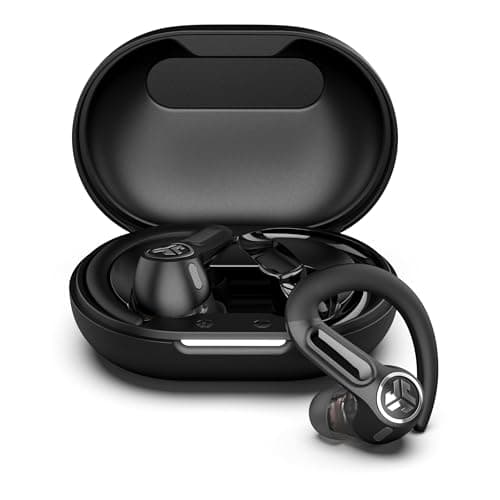
JLab Epic Sport ANC 3
In-ear + ear hook8.5/10The sealed answer: hybrid ANC, IP66, dual drivers with LDAC and wireless charging, for a lot less than the flagship sealed buds.
$104.99Amazon#ad · Price as of October 17, 2026 · Disclosure for the link to JLab Epic Sport ANC 3
How we scored this
The research behind every pick
Each pair on this page is researched and compared the same way: we classify the retention system that holds it on (hook, clip, wing, neckband), read the maker's published IP rating, weight, battery, charging, mic and control type straight off its own product page and manual, check the sweat and water rating against the IEC 60529 standard, cross-reference independent published reviews, and score every pick on a public rubric. Every figure links to the document it came from, so you can check any number in one click.
Prices come live from Amazon, so what you see is what you pay today. Commissions never set a score or decide a pick. The rubric and its weights are published.
Questions
Frequently asked
Do open-ear earbuds have noise cancelling?
Why can't open-ear earbuds do ANC?
What is Shokz Open-Ear Noise Reduction?
Is there any open-ear earbud with true ANC?
Does ENC mean noise cancelling?
Keep reading
Related on Openear Club
- Best open-ear with noise cancelingThe ranked version, with the two exceptions in order.
- Open-ear vs in-ear earbudsThe seal, and everything that depends on it.
- Open-ear earbuds sound leakageIf the problem is privacy rather than quiet.
- What are open-ear headphones?The three designs and what each one does.
Receipts
Sources
- Shokz — official product comparison table (checked 2026-09-21)
- Shokz — OpenFit Pro product page (checked 2026-09-21)
- Soundcore — AeroFit 2 Pro product page (checked 2026-09-21)
- JLab — Epic Sport ANC 3 product page, tech specs (checked 2026-09-21)
- Shokz — OpenDots 2 product page (checked 2026-09-21)
- Shokz — In-Ear, Semi-In-Ear and Open-Ear Headphones Explained, NIKI Jane, April 7, 2026 (checked 2026-09-24)
- NIDCD (NIH) — Noise-Induced Hearing Loss (checked 2026-09-21)
Every spec here is traceable: figures come from the maker's own product pages and are linked on each product, independent findings are attributed to whoever published them, and prices come live from Amazon so the number you see is the number you pay today. Read the full method.