Open-Ear Earbuds · Guide
What are open-ear headphones?
They play sound at your ear instead of inside it. That one change fixes the two complaints that bring most people here - earbuds falling out and earbuds you cannot hear past - and it costs you bass and privacy.
By Mike M.Updated Researched · every spec sourced
#adReader-supported: we may earn a commission if you buy through our links, at no extra cost to you. It never decides a ranking. How we rank · Disclosure
The definition
Two terms you will see used loosely alongside it. Semi-in-ear means a bud that rests in the concha without sealing the canal — the original AirPods shape. It leaks like an open-ear product and holds on by nothing much at all, so it gets the worst of both. Air conduction and bone conduction are the two sound-delivery methods inside the open-ear category, and the difference between them is set out in bone conduction vs air conduction.
The three designs
Everything that genuinely qualifies as open-ear uses one of three mechanisms to stay on your head.
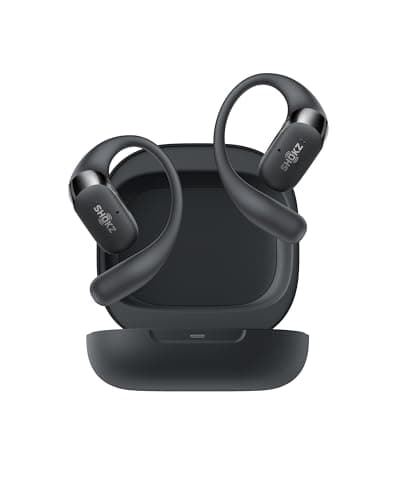
1. The ear-hook (air conduction). A silicone-covered arc hooks over the top of your ear and hangs a pod containing the driver and the battery in front of the canal. It is the largest of the three, so it carries the biggest driver and the longest battery: the Shokz OpenFit 2 is 9.4 g per side with 11 hours per charge. The cost is that the hook occupies the groove over your ear, where glasses arms and helmet straps already live.
2. The clip-on cuff (air conduction). A barrel containing the speaker and a counterweight pinch the rim of your ear between them, like a clip-on earring. Lightest of the three — 5 to 6.5 g per side — and the only one that leaves the top of the ear completely free, which is why glasses wearers gravitate to it. It holds by compression rather than friction, and a thin ear rim is its one failure mode. The two air designs are compared in ear-hook vs clip-on open-ear earbuds.
3. The bone conduction neckband. A sprung titanium band passes behind your head and presses two transducers against your cheekbones, just in front of the ear. Sound travels as vibration through bone to the inner ear, bypassing the eardrum entirely. Heaviest of the three at 26 to 31 g, and the most secure: nothing touches the ear at all, so nothing can be dislodged from it. How that actually works is in how do bone conduction headphones work?
What they sound like
Honestly: thinner than a sealed earbud, and the reason is physics rather than engineering effort.
Low frequencies need a lot of air movement. A sealed tip gets that for free by pressurising a tiny trapped volume. An open-ear driver is pushing air into an open room, so the same bass note requires a much bigger excursion from a much smaller driver, and whatever it does produce is competing with unattenuated ambient noise. Makers answer with larger drivers, dual drivers (Shokz DualBoost), and aiming technologies that direct sound into the canal and cancel what escapes sideways (Shokz DirectPitch, Soundcore and Cleer equivalents). Those help. They do not close the gap.
Bone conduction is thinner again. Producing real bass through the skull would mean vibrating it hard enough that you feel a buzz on your cheekbone rather than hear a bass line, which is why SoundGuys describes sub-bass and bass across the whole bone conduction category as virtually inaudible. The one exception on this site is the Shokz OpenRun Pro 2, which adds a small air-conduction driver specifically for the low end. The full version is in do bone conduction headphones sound good?
Practical read: for podcasts, audiobooks, radio and most music while you move, open-ear sound is entirely fine. If you listen critically, or you want to feel a bass line in a loud gym, it is not.
What you gain: awareness and fit
Two things, and they are the reason the category exists.
Awareness. Your canal stays an open tube, so traffic, a bike bell, a coach or a colleague arrives at your eardrum the way it always has — including the timing and level differences between your two ears that let you tell which direction it came from. A transparency mode on a sealed earbud routes the world through microphones, a processor and a driver, and localisation suffers. For road running that difference is the whole argument: see can you hear traffic with open-ear headphones?
Fit security. There is no seal to lose. A sealed tip holds by friction against skin that gets warmer and wetter as you work, which is exactly why it drifts; take the tip out of the equation and the drift stops. Open-ear designs very rarely fall out, and the mechanics are in do open-ear earbuds fall out?
A third, smaller gain: comfort over hours. Nothing is pressing outward inside your canal, which removes one of the common mechanical causes of ear ache from earbuds — the others are in why do my earbuds hurt my ears?
What you give up
- Bass, as above. Not negotiable; it is the price of an open canal.
- Isolation. There is nothing between you and the room, so a loud gym or a plane is loud. Active noise cancelling needs a seal to work against, so most open-ear products cannot do it at all — what the box usually means by “noise cancelling” is microphone processing for calls. The exceptions are in best open-ear earbuds with noise canceling.
- Privacy. Open-ear headphones leak audibly, because sound that is not funnelled into your canal goes somewhere. At street and gym volumes nobody notices; in a quiet office or a waiting room they do. What controls it is in open-ear earbuds sound leakage.
- Hearing safety is not automatic. Open-ear is often sold as gentler on your hearing, and that is only half true: sound still reaches the cochlea, and an open design quietly invites you to raise the volume to beat the ambient noise it does not block. See open-ear headphones and hearing safety.
Who should buy which
Buy an ear-hook if you want the best open-ear sound and the longest battery, and nothing else is sitting over your ear. It is the default for most people and the reason the OpenFit 2 leads best open-ear earbuds.
Buy a clip-on if you wear glasses, a cap or a helmet, or if you want the lightest thing available. It is also now the open-ear style with the best water ratings: the Shokz OpenDots 2 is IP57 on the buds with an IP54 case, and the Baseus Bowie MC2 is IP67. Every cuff is ranked in best clip-on earbuds.
Buy a bone conduction neckband if absolute security is the point — trail running, open water, a sport where something might knock an earbud off — or if a conventional earbud is uncomfortable in the ear at all. The category is ranked in best bone conduction headphones, and the head-to-head against the air designs is open-ear vs bone conduction.
Stay with sealed in-ears if you commute by plane or train, work in an open office, or care more about sound quality than awareness. That comparison is open-ear vs in-ear earbuds.
Picks
Our picks for this
One of each design, plus a cheap way to try the idea
If you want to find out whether open-ear suits you, these are the four we would start people on: the default hook, the best-rated clip, the most secure neckband, and a budget hook that still publishes an IP55 rating.
Best open-ear earbuds overall
Shokz OpenFit 2
Open-ear hook8.3/10The reference ear-hook: 11 hours per charge, IP55 buds, a physical button and dual drivers for the fullest open-ear sound here.
$179.95Amazon#ad · Price as of October 17, 2026 · Disclosure for the link to Shokz OpenFit 2
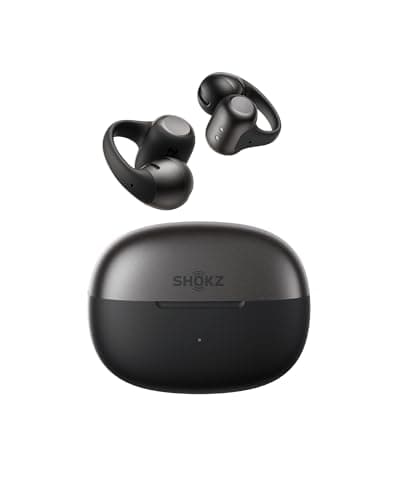
Best clip-on for sweat
Shokz OpenDots 2
Open-ear clip-on8.6/10The clip to buy: IP57 earbuds and an IP54 case, 6.4 g, and nothing over the top of your ear to fight glasses.
$199.95Amazon#ad · Price as of October 17, 2026 · Disclosure for the link to Shokz OpenDots 2
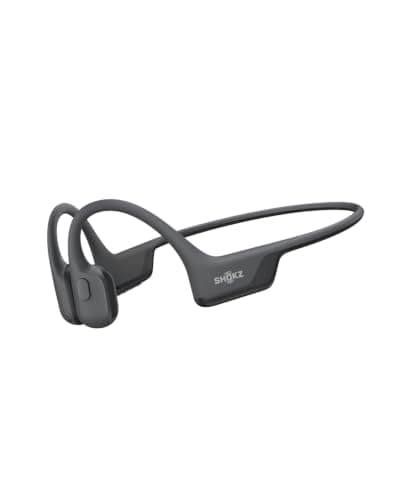
Best for heavy sweaters
Shokz OpenRun Air 2
Bone conduction (neckband)8.7/10The neckband: IP67 so you can rinse it, 26.4 g, 10 hours, and nothing touching your ear at all.
$129.95Amazon#ad · Price as of October 17, 2026 · Disclosure for the link to Shokz OpenRun Air 2
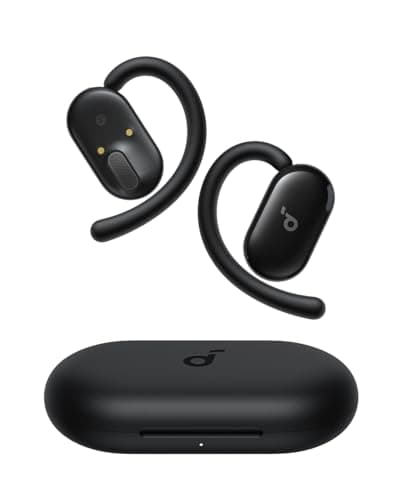
Best open-ear under $100
Soundcore V20i
Open-ear hook7.7/10The cheap way in: IP55, four adjustable hook positions and 8 hours, so you can test the concept before spending.
$29.99Amazon#ad · Price as of October 17, 2026 · Disclosure for the link to Soundcore V20i
How we scored this
The research behind every pick
Each pair on this page is researched and compared the same way: we classify the retention system that holds it on (hook, clip, wing, neckband), read the maker's published IP rating, weight, battery, charging, mic and control type straight off its own product page and manual, check the sweat and water rating against the IEC 60529 standard, cross-reference independent published reviews, and score every pick on a public rubric. Every figure links to the document it came from, so you can check any number in one click.
Prices come live from Amazon, so what you see is what you pay today. Commissions never set a score or decide a pick. The rubric and its weights are published.
Questions
Frequently asked
What are open-ear headphones?
Are open-ear headphones the same as bone conduction?
Do open-ear headphones have good sound quality?
Can other people hear my open-ear headphones?
Are open-ear headphones good for running?
Do open-ear headphones have noise cancelling?
Keep reading
Related on Openear Club
Receipts
Sources
- Shokz — In-Ear, Semi-In-Ear and Open-Ear Headphones Explained, NIKI Jane, April 7, 2026 (checked 2026-09-24)
- Shokz — official product comparison table (checked 2026-09-21)
- Shokz — bone conduction technology page (checked 2026-09-21)
- SoundGuys — Best bone conduction headphones, Chase Bernath, updated Jan 23, 2026 (checked 2026-09-21)
- Shokz — OpenDots 2 product page (checked 2026-09-21)
- Soundcore — V20i product page (checked 2026-09-21)
Every spec here is traceable: figures come from the maker's own product pages and are linked on each product, independent findings are attributed to whoever published them, and prices come live from Amazon so the number you see is the number you pay today. Read the full method.