Bone Conduction · Guide
How do bone conduction headphones work? A vibrating plate on your cheekbone, and an empty ear canal
There is no speaker aimed at your ear. A small transducer presses against the bone in front of your ear canal and shakes it, and your skull delivers the sound to the same place an eardrum would have. Everything good and bad about the category follows from that one sentence.
By Mike M.Updated Researched · every spec sourced
#adReader-supported: we may earn a commission if you buy through our links, at no extra cost to you. It never decides a ranking. How we rank · Disclosure
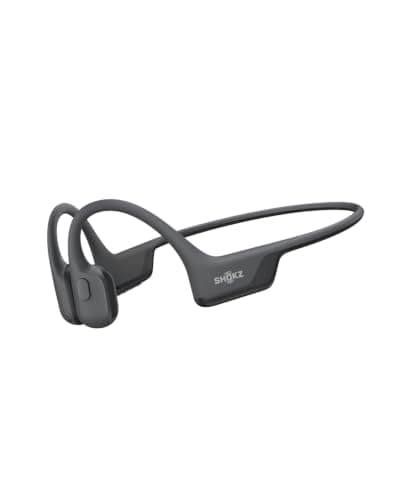
The mechanism in four steps
- An electrical signal arrives. Exactly as in any wireless headphone: Bluetooth delivers audio to a chip, which drives an output stage.
- A transducer converts it to movement, not air pressure. This is the one step that differs. Instead of a cone pushing air, a small plate is driven back and forth against your skin. You can feel it if you hold a playing pair in your hand — it buzzes.
- Your skull carries the vibration. Bone is a good conductor of mechanical vibration. The temporal bone, which is the one the transducer rests on, routes it inward.
- The cochlea receives it and does its normal job. Vibration moves the cochlear fluid, which moves the hair cells, which fire the auditory nerve. From this point on, the process is identical to hearing anything else.
You already know what this feels like, incidentally. Your own voice reaches your cochlea partly by bone conduction through your jaw and skull, which is why a recording of yourself sounds wrong: the recording only has the air-conducted half.
What is actually in the housing
Open a bone conduction neckband conceptually and there are five parts, four of which are unremarkable:
- Two transducers, one per side, positioned to land in front of the ear canal on the cheekbone.
- A sprung frame, usually titanium, running around the back of the head. It is a spring, and its job is to supply steady clamping pressure — too little and the transducers lose contact and the sound thins, too much and your temples ache.
- A battery and a Bluetooth radio, split between the two arms. This is why the arms are thicker than the band.
- Microphones, beside your temple. Shokz publishes wind resistance to 25 km/h on its current wind-rated models; the OpenComm2 UC moves the mic onto a boom arm in front of your mouth instead.
- Physical buttons, almost universally, because the category's buyers have wet hands.
One structural consequence worth noting: there is no lid, no hinge and no charging case, so a neckband is a single sealed object. That is why this category carries the strongest water ratings on this site — IP67 on the OpenRun Air 2, IPX8 on the Creative Outlier Free Pro, IP68 on the OpenSwim Pro and Mojawa Run Plus — where true wireless earbuds with cases often stop at IPX4.
What gets bypassed, and what does not
Bypassed: the outer ear, the ear canal and the eardrum, plus the three middle-ear bones that normally amplify the eardrum's movement.
Not bypassed: the cochlea, the hair cells inside it, and the auditory nerve. Every bit of hearing that can be damaged by noise sits on the far side of the bypass. That is the single most misunderstood fact about the category, and it is why the safety claim people read into the word “bypassing” does not hold. We take it apart in do bone conduction headphones cause hearing loss?
The bypass does genuinely help one group: people with conductive hearing loss, where the outer or middle ear is blocked or damaged. Routing around a blocked section restores a path. That is not the same as a hearing aid and it does nothing for sensorineural loss — the distinction is in bone conduction for hearing loss.
Why there is no bass
Practical consequence: speech, podcasts, audiobooks and coaching cues come through cleanly, and music with a bass line sounds hollow. It also sets up the one real hearing risk, because people turn the volume up chasing a low end that is never going to arrive. The sound question in full is at do bone conduction headphones sound good?
How makers work around it
There is only one honest workaround and Shokz ships it: add a conventional air-conduction driver beside the bone transducer and let it cover the low end. That is what DualPitch is on the OpenRun Pro 2 — a 10th-generation system that is bone conduction plus a small speaker. It is audibly fuller than the bone-only models and still behind a decent open-ear ear-hook.
Everything else in the category is marketing on top of the same physics: PremiumPitch 3.0 on the OpenRun Air 2, PremiumPitch 2.0+ on the OpenRun, 7th-generation on the OpenMove. Those are generation labels for bone-only transducers, and the differences between them are real but small. The hybrid versus pure comparison is in bone conduction vs air conduction.
How they stay on without touching your ears
This is the question people actually ask after “how do they work,” and the answer is the frame, not the ears. The band is a spring with a fixed arc; it grips the back and sides of your skull and holds the transducers in place by pressure. Nothing hooks over your ear, nothing enters the canal, nothing adheres.
Which means retention is a sizing problem and nothing else. Too large an arc and the band bounces on footstrike; too small and it clamps your temples until they ache. Shokz sells Standard and Mini and publishes the cutoff — roughly 9.25 inches of head circumference — and getting that choice right matters more than any other decision in the category. What goes wrong at each end, and how to measure, is in best bone conduction headphones for big heads.
Because retention is structural rather than frictional, every neckband we rank scores 10 for fit security. There is no mechanism by which it works loose the way a silicone tip does, which is exactly why the category exists for the reader whose earbuds keep falling out. If that is you, start at best earbuds that don't fall out.
What it feels like
Three sensations surprise new wearers, and all three are normal:
- Sound that seems to come from inside your head. There is no sound source at your ear, so the usual directional cues are missing. Most people stop noticing within a day.
- A tickle on the cheekbone at volume. The transducer's displacement reaching your threshold of touch. Treat it as a volume warning.
- Hearing everything around you, undiminished. Nothing is covering your ear canal, so traffic, a bike bell or a gym PA arrives with no processing and no latency. That is the other half of why the category exists — see can you hear traffic with open-ear headphones?
Why they go silent underwater
Bone conduction works beautifully in water — better than in air, if anything, because water couples to your head. The problem is upstream: Bluetooth is a 2.4 GHz radio and water absorbs it within centimetres. H2O Audio says it outright on its own product page — Bluetooth does not work underwater.
So swim-capable models solve it by removing the radio from the chain: the Shokz OpenSwim Pro carries 32 GB of onboard MP3 storage, the Creative Outlier Free Pro 8 GB, the Mojawa Run Plus 32 GB. You load files and the headphone plays them locally. A neckband that is merely IP68 with no storage cannot be used for laps, which is a trap worth knowing before you buy. The swim set is ranked in best bone conduction headphones for swimming.
Picks
Our picks for this
Three pairs that show what the mechanism can do
The bone-only workhorse, the hybrid that adds an air driver for the low end, and the one with onboard storage because Bluetooth cannot follow you into the pool.
Best for heavy sweaters
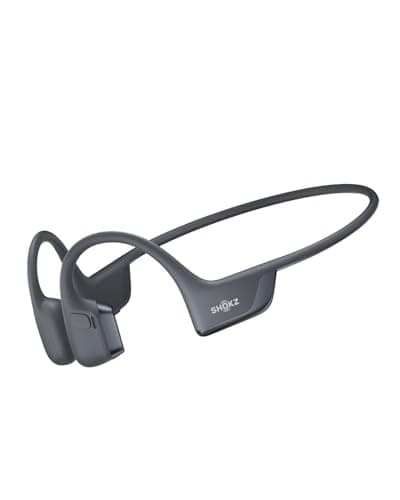
Shokz OpenRun Air 2
Bone conduction (neckband)8.7/10Pure bone conduction done properly: IP67, 26.4 g, 10 hours, Bluetooth 6.0, two frame sizes.
$129.95Amazon#ad · Price as of October 11, 2026 · Disclosure for the link to Shokz OpenRun Air 2
Best bone conduction overall
Shokz OpenRun Pro 2
Bone conduction (neckband)8.5/10DualPitch: a bone transducer plus a real air-conduction driver, which is the only working answer to the bass limit.
$179.95Amazon#ad · Price as of October 11, 2026 · Disclosure for the link to Shokz OpenRun Pro 2
Best for swimming
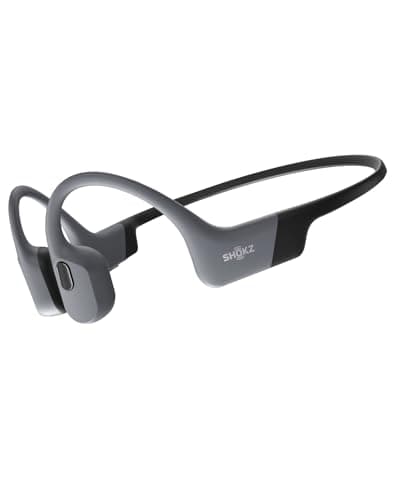
Shokz OpenSwim Pro
Bone conduction (neckband)8.5/10IP68 to 2 m with 32 GB of onboard MP3 storage, because a radio cannot reach you underwater.
$229.95Amazon#ad · Price as of October 11, 2026 · Disclosure for the link to Shokz OpenSwim Pro
How we scored this
The research behind every pick
Each pair on this page is researched and compared the same way: we classify the retention system that holds it on (hook, clip, wing, neckband), read the maker's published IP rating, weight, battery, charging, mic and control type straight off its own product page and manual, check the sweat and water rating against the IEC 60529 standard, cross-reference independent published reviews, and score every pick on a public rubric. Every figure links to the document it came from, so you can check any number in one click.
Prices come live from Amazon, so what you see is what you pay today. Commissions never set a score or decide a pick. The rubric and its weights are published.
Questions
Frequently asked
How do bone conduction headphones work?
How do bone conduction headphones stay on?
Do bone conduction headphones work with glasses?
Do bone conduction headphones work underwater?
Can other people hear bone conduction headphones?
Why does my own voice sound different with them on?
Keep reading
Related on Openear Club
Receipts
Sources
- Shokz — bone conduction technology page (checked 2026-09-21)
- Shokz — official product comparison table (checked 2026-09-21)
- Surendran, Prodanovic & Stenfelt, Hearing Through Bone Conduction Headsets, Trends in Hearing 27 (2023), NIH PMC (checked 2026-09-26)
- SoundGuys — Best bone conduction headphones, Chase Bernath, updated Jan 23, 2026 (checked 2026-09-21)
- Occlusion effect — definition and low-frequency mechanism, Wikipedia (checked 2026-09-24)
- H2O Audio — TRI 2 PRO product page (checked 2026-09-21)
- Shokz — OpenRun vs. OpenRun Mini: find your perfect fit (checked 2026-09-26)
- Creative — Outlier Free Pro product page, specifications (checked 2026-09-21)
Every spec here is traceable: figures come from the maker's own product pages and are linked on each product, independent findings are attributed to whoever published them, and prices come live from Amazon so the number you see is the number you pay today. Read the full method.