Bone Conduction · Guide
Shokz Standard vs Mini: how to pick the size before you buy, not after
A Shokz neckband has no fit adjustment. The band is a fixed sprung arc, so either it matches your head or it bounces on every stride. One tape-measure reading settles it, and Shokz publishes the cut-off.
By Mike M.Updated Researched · every spec sourced
#adReader-supported: we may earn a commission if you buy through our links, at no extra cost to you. It never decides a ranking. How we rank · Disclosure
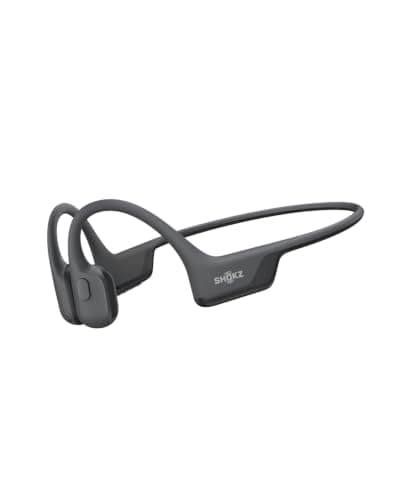
The direct answer
One clarification that saves a lot of confusion: Mini is not a kids' or women's version. It is the same product with a shorter band, sold at the same price with the same specification. Shokz also frames it as a preference, not only a measurement — its sizing post recommends Mini for anyone “with a smaller head size or you prefer your headphones to have a snug fit.”
How Shokz says to measure
Shokz's instruction is specific, and the specificity matters because almost everyone measures the wrong line first:
“Measure your head between the mid-point behind your left ear and the midpoint behind your right ear.”
- Find the midpoint behind one ear. Not the top of the ear and not the earlobe — the middle of where the ear meets your skull. That is where the band's arm will actually sit.
- Run a soft tape around the back of your head to the same point behind the other ear. Follow the curve of the skull; do not pull the tape straight across.
- Keep it snug, not tight. You are measuring the path the band takes, not compressing anything.
- Read it. Over 9.25 in / 23.49 cm is Standard. At or under is Mini.
Note what this is not: it is not hat size, and it is not the full circumference around your forehead. A forehead measurement is several inches larger and will push almost everyone to Standard, which is exactly how people end up with a band that bounces. If you have no tape measure, a length of string marked with a pen and then laid against a ruler works fine.
What actually differs
Less than people expect. The two sizes differ in band length and a fraction of a gram, and in nothing else.
| Factor | Standard | Mini |
|---|---|---|
| Head measurement (Shokz) | Over 9.25 in / 23.49 cm | 9.25 in / 23.49 cm or less |
| Band length | Full length | Shorter: Shokz's sizing post says “a half-inch shorter band”; its OpenRun page states “a 0.83 inch shorter band size” |
| OpenRun Pro 2 weight | 30.3 g | 30 g |
| OpenRun Air 2 weight | 26.4 g | 25.9 g |
| OpenRun weight | 26.4 g | 26 g |
| Drivers, IP rating, battery, mics, controls | Identical | |
| Price | Identical | |
The two band figures are worth flagging rather than averaging: Shokz's sizing blog says half an inch and its OpenRun product page says 0.83 inch, and we are not going to invent a number in between. Either way the gap is under an inch of band length, and on a sprung arc that is enough to change the clamping pressure noticeably — which is the whole point.
What each wrong size feels like
If you already own a pair and something is off, the symptom tells you which way you went wrong. These are the two failure modes, and they are opposites.
Standard when you needed Mini: it bounces and the sound thins
- Movement on footstrike. The band has play in it, so every stride lifts and drops it. You feel it tapping the back of your neck or your collar.
- The sound gets thinner as you run. This is the diagnostic one. Bone conduction needs contact pressure: if the transducers lift off the cheekbone even slightly, the transmission drops and you lose what little low end the design has. If your headphones sound fine standing still and hollow at pace, the band is too long.
- You find yourself pushing them back. Repeatedly, mid-run, with one hand.
- Shokz says it directly: “If you have a pair of Shokz and feel they are too loose for your head consider OpenRun Mini for your next purchase.”
Mini when you needed Standard: it aches at the temples
- Pressure in front of the ears or at the temples, building over the first 30 to 60 minutes rather than being obvious at the start. Sustained pressure on cartilage reduces blood flow, which is why a fit that feels fine in the shop hurts on a long run.
- A red mark where the transducer sits after you take them off.
- Glasses become unbearable, because the band is already competing for the space behind your ears and now it is pressing the arms into your skull.
Both of those are size problems rather than product problems, and no amount of adjustment fixes either. If the ache is in your ear rather than at your temple, the cause is probably different — see why do my earbuds hurt my ears?
Which models come in both
Shokz offers Standard and Mini across its current neckband line: the OpenRun Air 2 and OpenRun Pro 2, the OpenRun and the OpenMove. The registry weights above come from Shokz's own comparison table, and the Mini figures exist for each of them, which is the clearest confirmation that both sizes ship.
What does not come in two sizes is everything that is not a neckband. The OpenFit ear-hooks and the OpenDots clip-ons attach to the ear itself rather than wrapping the skull, so head circumference is irrelevant to them — their fit question is ear shape, which is a different problem with different answers. If your measurement sits awkwardly on the line, that is a genuine reason to consider a hook or a clip instead; the three fit systems are compared in open-ear vs bone conduction.
The swim models are the exception worth naming: the OpenSwim Pro is sold in a single size, so if you are between sizes and buying for the pool you are committing to the standard arc. The pool-specific ranking is in best bone conduction headphones for swimming.
Edge cases: hats, glasses, ponytails, kids
- You wear a winter hat or a buff. Measure without it. A hat adds thickness under the band and pushes a borderline reading toward Standard, but you will wear the headphones in summer too, and a band sized for a hat is loose for nine months of the year. Put the band on first and the hat over it.
- You wear glasses. Measure without them as well, but weight a borderline reading toward Standard: the arms are already occupying the space behind your ears, and a Mini that is slightly tight becomes a Mini that is painful once glasses are in the same place. What works and what fights is in open-ear earbuds with glasses.
- You run with a ponytail or a bun. Low ponytails sit below the band and cause no trouble; a high bun does not interfere either, because the band crosses the occipital bone rather than the crown. Do not size up for hair.
- You are buying for a child or teenager. Measure them rather than assuming Mini. Mini is a band length, not an age bracket, and a growing head will outgrow it. Our picks and the volume caveats for younger runners are in best running headphones for kids.
- You are between 9.0 and 9.5 inches. Honest answer: Shokz draws the line at 9.25 and gives no tolerance, so right on the line it becomes a preference. Prefer a snug fit or do a lot of impact work, take Mini; prefer light contact, wear glasses all day or often wear a hat, take Standard.
If you already bought the wrong one
There is no modification that works and we are not going to suggest one — bending a titanium band changes its spring rate permanently, and a band that has been bent does not hold the transducers evenly. Three real options, in order:
- Return or exchange it within the window. This is the only clean fix. Measure first, so the replacement is right.
- If it is too loose and you are outside the window, keep it for walking, gym work and desk use where there is no footstrike, and treat the next pair as the running pair. A loose band is an annoyance standing still and a deal-breaker at pace.
- If it is too tight, it will not loosen with wear in any meaningful way. Shorten the sessions, and consider moving to an ear-hook or clip-on, where retention does not depend on skull circumference at all.
Picks
Our picks for this
Four Shokz neckbands, each sold in Standard and Mini
Every one of these ships in both sizes at the same price, so the measurement decides the variant and the spec sheet decides the model. Weights below are Shokz's own, Standard first.
Best for heavy sweaters
Shokz OpenRun Air 2
Bone conduction (neckband)8.7/1026.4 g Standard / 25.9 g Mini. IP67, 10 hours, Bluetooth 6.0 - the value pick in the line.
$129.95Amazon#ad · Price as of October 12, 2026 · Disclosure for the link to Shokz OpenRun Air 2
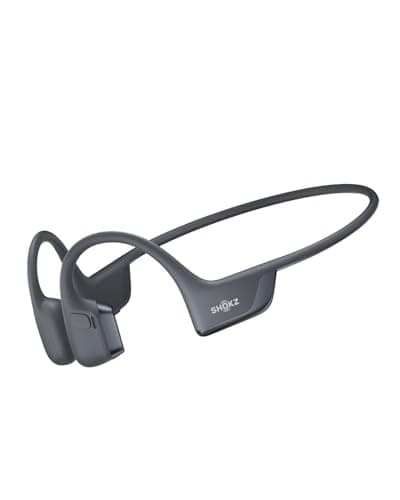
Best bone conduction overall
Shokz OpenRun Pro 2
Bone conduction (neckband)8.5/1030.3 g Standard / 30 g Mini. The only one with a DualPitch air driver for the low end, and 12 hours.
$179.95Amazon#ad · Price as of October 12, 2026 · Disclosure for the link to Shokz OpenRun Pro 2
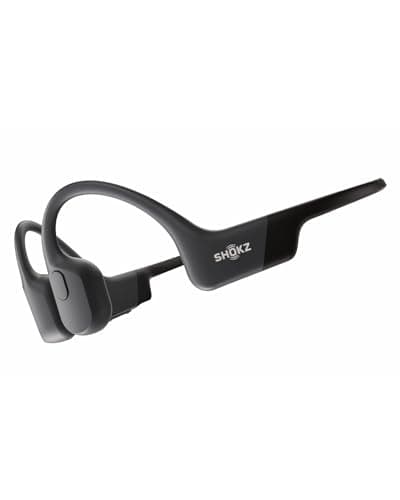
Best-known running pick
Shokz OpenRun
Bone conduction (neckband)8.1/1026.4 g Standard / 26 g Mini. IP67 with a moisture detector; 2019 electronics, so buy on a discount.
$129.95Amazon#ad · Price as of October 12, 2026 · Disclosure for the link to Shokz OpenRun
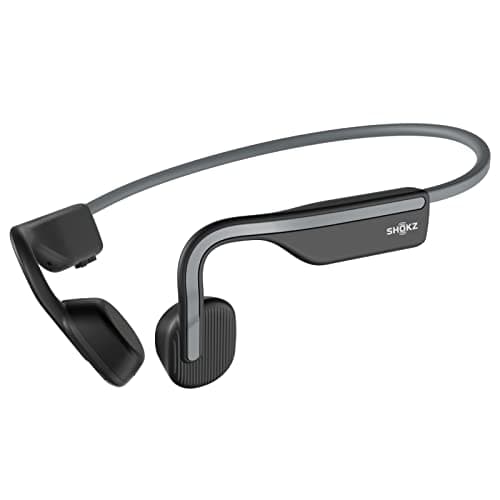
Best Shokz under $100
Shokz OpenMove
Bone conduction (neckband)7.4/1029 g. The cheapest way into the Shokz frame: IP55, 6 hours, USB-C, no quick charge.
$79.95Amazon#ad · Price as of October 12, 2026 · Disclosure for the link to Shokz OpenMove
How we scored this
The research behind every pick
Each pair on this page is researched and compared the same way: we classify the retention system that holds it on (hook, clip, wing, neckband), read the maker's published IP rating, weight, battery, charging, mic and control type straight off its own product page and manual, check the sweat and water rating against the IEC 60529 standard, cross-reference independent published reviews, and score every pick on a public rubric. Every figure links to the document it came from, so you can check any number in one click.
Prices come live from Amazon, so what you see is what you pay today. Commissions never set a score or decide a pick. The rubric and its weights are published.
Questions
Frequently asked
How do I know if I need Shokz Standard or Mini?
What is the difference between Shokz Standard and Mini?
Is Shokz Mini for women or children?
My Shokz bounce when I run. Are they the wrong size?
Do the OpenFit earbuds or OpenDots clip-ons come in Mini?
Can I bend the band to make it fit?
Keep reading
Related on Openear Club
Receipts
Sources
- Shokz — OpenRun vs. OpenRun Mini: find your perfect fit (checked 2026-09-26)
- Shokz — OpenRun overview page, OpenRun Mini band size (checked 2026-10-12)
- Shokz — official product comparison table (checked 2026-09-21)
- Shokz — bone conduction technology page (checked 2026-09-21)
- Shokz — OpenRun Pro 2 product page (checked 2026-09-21)
Every spec here is traceable: figures come from the maker's own product pages and are linked on each product, independent findings are attributed to whoever published them, and prices come live from Amazon so the number you see is the number you pay today. Read the full method.