Open-Ear Earbuds · Guide
Open-ear earbuds vs AirPods: the difference is not waterproofing
Most comparisons assume the Apple option is the fragile one. It is not - AirPods Pro 3 are IP57 on the buds and the case. The real split is how they stay in your ears and whether the room reaches you through a microphone or your own eardrum.
By Mike M.Updated Researched · every spec sourced
#adReader-supported: we may earn a commission if you buy through our links, at no extra cost to you. It never decides a ranking. How we rank · Disclosure
The direct answer
The comparison table
One open-ear hook, one open-ear clip and the AirPods Pro 3, every figure as published by the maker and linked per row.
1. Water: Apple is better than you think
IP57 breaks down as 5 for solids — dust-protected — and 7 for water, which under IEC 60529 means immersion to a metre for 30 minutes. That is an immersion rating on an earbud most people think of as an office accessory, and Apple extends it to the case, which almost nobody does.
Two honest caveats, both of which apply to every brand equally. The IP tests use fresh water, so chlorine, soap and salt are outside the spec; sweat in particular is salt water with skin oils that dry into a hygroscopic crust on charging contacts. And a water rating is not a warranty — liquid damage is routinely excluded. The mechanism and the habits are in can sweat damage earbuds? and how to clean sweaty earbuds.
So if your last pair died of sweat, the lesson is not “avoid AirPods.” It is to read the second digit of the IP code on whatever you buy next and to rinse when the rating permits it. The ladder is in IPX4 vs IPX5 vs IPX7.
2. Retention: the actual difference
This is the reason most people end up on this site. An AirPods Pro 3 has five tip sizes, from XXS to L, and a fit test in iOS that checks the seal. Both are genuinely useful and neither changes the mechanism: the bud stays in because a silicone tip presses outward against the canal wall, and that pressure is converted into holding force by friction.
Warm, wet skin has less friction. So the failure is progressive rather than sudden: bass thins first, because a seal that is nearly there is acoustically no seal, then you push it back in, then it creeps again. On a long run or in the back half of a session that loop is what people describe as “they keep falling out.”
Open-ear designs each substitute a different mechanism:
- Ear-hook: a silicone arc over the top of the ear carries the weight. Nothing in the canal.
- Clip-on cuff: compression on the outer ear rim, which is skin over cartilage rather than skin inside a tube.
- Bone conduction neckband: a sprung band behind the head, with nothing touching the ear at all.
The designs are described in full in what are open-ear headphones?, and the honest answer to whether they stay put is in do open-ear earbuds fall out? If you would rather keep a seal and add a hook, that option exists too — it is the third category, and the fourth pick below.
3. Awareness: transparency is not an open canal
Apple's Transparency mode is very good. Microphones on the outside of each bud capture the room and feed it to the driver, with Adaptive Audio and Conversation Awareness adjusting it automatically. For a shop, an office or a platform announcement it is close to seamless.
What it is not is your own hearing. The signal goes through a microphone, a processor and a speaker, in a pipeline with latency, and your pinna — the shaped outer ear that filters sound differently depending on where it came from — has been bypassed, because the sound now arrives from a driver sitting in front of your eardrum rather than from the street. Those filtering cues are a large part of how you localise a sound. In practice people report knowing a car is there and being less sure where.
For road running and city cycling that is the whole argument for open-ear, and it is made at length in can you hear traffic with open-ear headphones? and safest headphones for running. There is also a battery consequence: Transparency and ANC both cost power, which is why the AirPods Pro 3 figure is up to 8 hours against 11 on the OpenFit 2.
4. Sound and isolation: Apple wins
No hedging here. A sealed canal is a pressure chamber, which is why the AirPods Pro 3 have bass that no open-ear earbud can produce, and it is also the thing active noise cancelling works against. Apple's ANC is the strongest of anything on this site. On a plane, a train or a treadmill next to a loud class, the sealed option is simply better.
Open-ear earbuds cannot do real ANC at all, because there is no seal to cancel into. What the boxes usually mean by “noise cancelling” is microphone processing for calls; the two genuine exceptions on this site work by listener-side processing or by sealing the ear on demand, and they are explained in do open-ear earbuds have noise cancellation?
The other side of the sound ledger is leakage. Open-ear earbuds are audible to the person next to you; sealed ones are not. If you share a quiet office, that matters — see open-ear earbuds sound leakage.
5. The ecosystem question
The AirPods Pro 3 carry a heart-rate sensor for workouts, instant pairing and handoff across iPhone, iPad, Mac and Apple Watch, Live Translation, and up to 10 hours in Transparency with the Hearing Aid feature. None of that is available from an open-ear brand, and most of it only works if you are on Apple devices anyway.
If that list is why you bought AirPods, the realistic move is not to replace them but to add a cheap open-ear pair for the sessions where they fail you. A budget hook or clip with an IP55 rating costs a fraction of a flagship: see best open-ear earbuds under $50. If you are on iPhone and want one pair that does both, the ranking is in best open-ear earbuds for iPhone; nothing in the open-ear category uses an Apple-specific chip, so pairing is ordinary Bluetooth and codecs beyond AAC do nothing on iOS.
Who should switch, and who should not
Switch if your AirPods drift out when you sweat, if your ears ache or itch with a tip in, or if you run and ride on roads and want awareness that is not routed through a microphone. Those are the three problems open-ear is actually built to solve.
Do not switch for durability (the IP57 rating is already strong), for sound quality (you will go backwards), for isolation on a commute (you will go a long way backwards), or because you were told bone conduction is safer for your hearing — it is not inherently, as open-ear headphones and hearing safetyexplains.
Consider the third option if you want to keep the seal and fix only the fit: a sealed earbud with an adjustable over-ear hook, where the hook carries the load and the tip only seals. That is the Soundcore Sport X20 below, and the field is ranked in best sweatproof earbuds. For the model-level head-to-head between Apple's buds and a bone conduction neckband, see Shokz vs AirPods.
Picks
Our picks for this
One of each answer to the question
The open-ear hook, the open-ear clip, the AirPods themselves for the reader who concludes they should stay, and the sealed-with-a-hook compromise.
Best open-ear earbuds overall
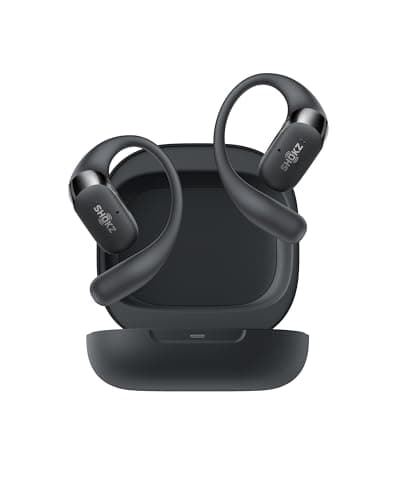
Shokz OpenFit 2
Open-ear hook8.3/10The straight open-ear swap: 11 hours, IP55 buds, a physical button, and a hook instead of a tip.
$179.95Amazon#ad · Price as of October 17, 2026 · Disclosure for the link to Shokz OpenFit 2
Best clip-on for sweat
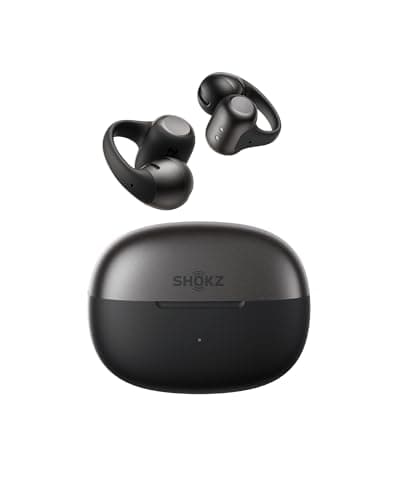
Shokz OpenDots 2
Open-ear clip-on8.6/10The lightest switch at 6.4 g, with IP57 buds and an IP54 case; nothing over the top of the ear.
$199.95Amazon#ad · Price as of October 17, 2026 · Disclosure for the link to Shokz OpenDots 2
Best ANC and iPhone integration
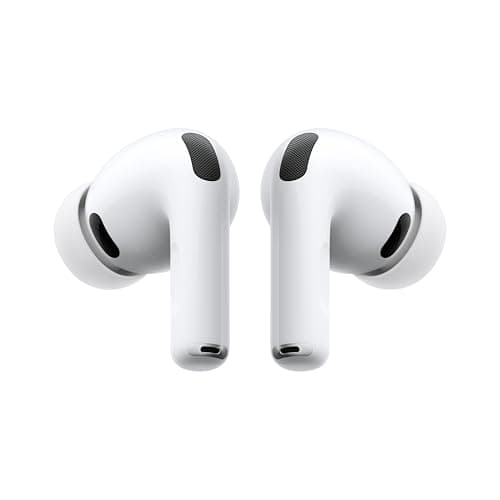
Apple AirPods Pro 3
Sealed in-ear (tip only)8.0/10IP57 on buds and case, the strongest ANC here and five tip sizes. Retention is still the tip and nothing else.
$199.00Amazon#ad · Price as of October 17, 2026 · Disclosure for the link to Apple AirPods Pro 3
Best sweatproof in-ear
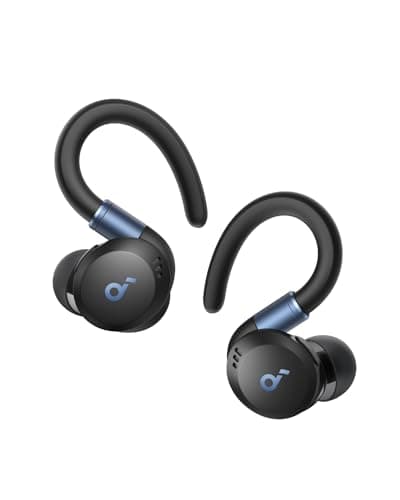
Soundcore Sport X20
In-ear + ear hook8.9/10Keep the seal, fix the fit: hooks that rotate 30 degrees and extend 4 mm, ANC, 12 hours and an immersion rating.
$69.99Amazon#ad · Price as of October 17, 2026 · Disclosure for the link to Soundcore Sport X20
How we scored this
The research behind every pick
Each pair on this page is researched and compared the same way: we classify the retention system that holds it on (hook, clip, wing, neckband), read the maker's published IP rating, weight, battery, charging, mic and control type straight off its own product page and manual, check the sweat and water rating against the IEC 60529 standard, cross-reference independent published reviews, and score every pick on a public rubric. Every figure links to the document it came from, so you can check any number in one click.
Prices come live from Amazon, so what you see is what you pay today. Commissions never set a score or decide a pick. The rubric and its weights are published.
Questions
Frequently asked
Are open-ear earbuds better than AirPods?
Are AirPods Pro 3 waterproof?
Why do my AirPods fall out when I run?
Is Transparency mode as good as open-ear?
Can I use open-ear earbuds with an iPhone?
Keep reading
Related on Openear Club
- Shokz vs AirPodsThe model-level head-to-head against a bone conduction neckband.
- Open-ear vs in-ear earbudsThe same trade-off as a category decision, in a table.
- What are open-ear headphones?The three designs, if the category is new to you.
- Best sweatproof earbudsSealed buds that keep the seal and add a hook.
Receipts
Sources
- Apple — AirPods Pro 3 technical specifications (checked 2026-09-26)
- Shokz — official product comparison table (checked 2026-09-21)
- Shokz — OpenFit 2 product page (checked 2026-09-21)
- Shokz — OpenDots 2 product page (checked 2026-09-21)
- Soundcore — Sport X20 product page (checked 2026-09-21)
- IEC 60529 (IP Code) — degree-of-protection definitions, Keystone Compliance summary (checked 2026-09-21)
- Apple — Headphone notifications on your iPhone, iPad, or Apple Watch (checked 2026-09-26)
Every spec here is traceable: figures come from the maker's own product pages and are linked on each product, independent findings are attributed to whoever published them, and prices come live from Amazon so the number you see is the number you pay today. Read the full method.