Bone Conduction · Guide
The disadvantages of bone conduction headphones
Seven real drawbacks, in the order they will actually bother you, with the published numbers behind each one - and the honest note on which are fixable and which are the physics you are buying into.
By Mike M.Updated Researched · every spec sourced
#adReader-supported: we may earn a commission if you buy through our links, at no extra cost to you. It never decides a ranking. How we rank · Disclosure
The short version
1. Almost no bass
This is the one that makes people return them. Bone conduction drives the cochlea by vibrating the skull, and low frequencies need large amplitudes. Producing real bass that way would mean shaking your head hard enough that you feel it on your cheekbone rather than hear it, which is a physical limit rather than an engineering gap. SoundGuys describes sub-bass and bass across the whole category as effectively inaudible.
The only hardware workaround in production is to add a conventional air-conduction driver for the low end alongside the bone transducer. On this site that is Shokz's DualPitch, in the OpenRun Pro 2 and nothing else. It is audibly fuller and it is still behind a decent air-conduction hook. The honest ranking is in do bone conduction headphones sound good?
Practical read: for podcasts, audiobooks, radio and training playlists this does not matter. For music you listen to rather than move to, it does.
2. Everyone near you can hear it
A vibrating transducer against your cheek also vibrates the air around it, so bone conduction radiates sound outward as well as inward. At gym and street volumes nobody notices. In a quiet office, a library, a train carriage or a shared bedroom, they do — and because you are hearing it through bone, your own sense of how loud it is outside your head is unreliable.
There is no mode that fixes this on any neckband we rank. The air-conduction designs do slightly better, because aiming technologies such as Shokz DirectPitch direct sound into the canal and cancel part of what escapes sideways, and Sony's LinkBuds Clip has an explicit leakage-protection mode. The full comparison is in open-ear earbuds sound leakage, and the work-focused picks are in best open-ear earbuds for work.
One upside worth noting: audible leakage is a free volume meter. If someone a metre away can make out the words, you are louder than you need to be.
3. Cheekbone vibration at volume
Past roughly half volume, the transducers stop being a sound source you only hear and start being something you feel. SoundGuys' review of the Suunto Wing describes vibration becoming noticeable above about 50% volume, which matches the general behaviour of the category rather than being specific to that model.
Two consequences. It is a comfort ceiling: there is a volume past which you will not want to go, which caps how well these work in genuinely loud environments. And for a minority of people the sensation is unpleasant at any useful volume, usually described as a tickle on the cheek, which is worth knowing before you buy rather than after.
Lighter clamping force and a well-fitted band reduce it. An oversized band makes it worse, because the transducers sit poorly and you compensate with volume — which is one more reason to measure before you buy, per Shokz Standard vs Mini sizing.
4. No isolation, and no ANC is possible
An open ear canal means ambient noise arrives at full strength. That is the feature on a road and the drawback on a plane, a train, an open-plan office or a treadmill next to a loud class.
Active noise cancelling cannot rescue it. ANC works by playing an inverted waveform into a small, sealed volume, and relies on the ear tip to passively block the high frequencies. With no seal, none of those conditions hold. Some neckbands advertise “noise cancelling” microphones; that processes your outgoing voice on calls and does nothing for what you hear. The full explanation is in do open-ear earbuds have noise cancellation?
5. 26 to 31 grams of neckband
Published weights across the neckbands we rank: 26.4 g for the Shokz OpenRun Air 2 and OpenRun, 27.3 g for the OpenSwim Pro, 29 g for the OpenMove, 29.6 g for the Mojawa Run Plus, 30.3 g for the OpenRun Pro 2, 31.5 g for the Creative Outlier Free Pro.
Set against a clip-on at 5 to 6.5 g per side, or an ear-hook at 7.2 to 12.3 g, that is four to six times the mass on your head. Over a 5K you will not notice. Over a four-hour long run or a full working day with glasses on, you will, and the Mini variant exists partly for that reason. Comfort over hours is covered in why do my earbuds hurt my ears?
6. The band fights benches, helmets and pillows
The band passes behind your head, which is a problem anywhere something else occupies that space:
- A weight bench or a seat back. Lie down and the band presses into your skull. For bench work and most machine work a hook or clip is simply the right shape — see best earbuds for lifting.
- A cycling helmet. The rear retention dial sits exactly where the band does. It can be made to work with the right put-on order and never by loosening a strap; the geometry is in headphones under a cycling helmet.
- A pillow or a car headrest. Both press the band into the back of your head. Side sleeping with a neckband on does not work.
- A hood or a high collar. Rubs and transmits noise into the transducers in winter.
7. You pay more for less hardware
The flagship neckbands sit at or above the price of better-sounding air-conduction hooks, and they do it with no charging case, fewer drivers and in some cases a proprietary charging cable rather than USB-C — the OpenSwim Pro and the Creative Outlier Free Pro both use magnetic cables, which is the price of a sealed housing. A neckband also has no case battery at all: the per-charge figure is the whole figure.
That is not a scandal; the band, the titanium and the waterproofing cost money, and a one-piece design cannot be lost one bud at a time. It is worth being clear-eyed about, especially against bone conduction under $100, where the ratings are often better than the flagships'.
What is fixable and what is not
Fixable by model choice: the bass, partly, with the OpenRun Pro 2's air driver. The weight, partly, with the 26.4 g Air 2 and the Mini band. The charging cable, by choosing a USB-C model. The water rating — the IP67 models can be rinsed where the IP55 ones cannot.
Not fixable: leakage, isolation, ANC and the shape of the band. Those are the mechanism.
Fixable by leaving the category: if sound and privacy matter more than absolute security, an air-conduction ear-hook keeps the open canal and sounds much better, and a clip-on does the same at a third of the weight with a better water rating. Both are below. The decision is laid out in bone conduction headphones vs earbuds and are bone conduction headphones worth it?
Picks
Our picks for this
One pick per deal-breaker
If one of the seven is the thing stopping you, here is what to do about it: the neckband that mitigates the bass, the one that mitigates the weight and the rating, and the two open-ear designs to move to if sound or privacy is the sticking point.
Best bone conduction overall
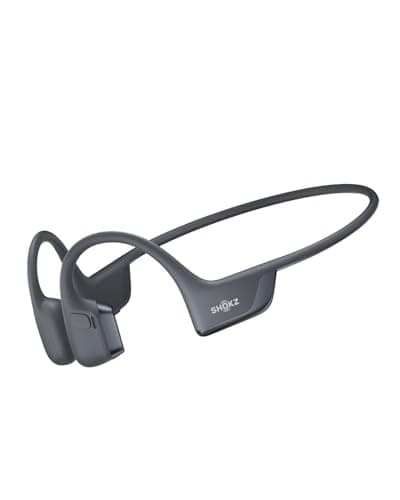
Shokz OpenRun Pro 2
Bone conduction (neckband)8.5/10If bass is the problem: DualPitch adds a real air-conduction driver for the low end, the only neckband here that has one. 12 hours, IP55.
$179.95Amazon#ad · Price as of October 17, 2026 · Disclosure for the link to Shokz OpenRun Pro 2
Best for heavy sweaters
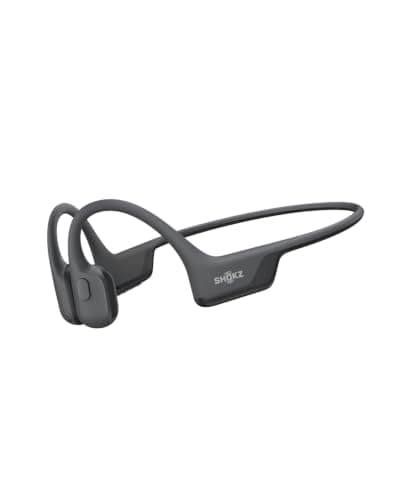
Shokz OpenRun Air 2
Bone conduction (neckband)8.7/10If weight and sweat are the problem: 26.4 g, IP67 so you can rinse it, Bluetooth 6.0 and USB-C.
$129.95Amazon#ad · Price as of October 17, 2026 · Disclosure for the link to Shokz OpenRun Air 2
Best open-ear earbuds overall
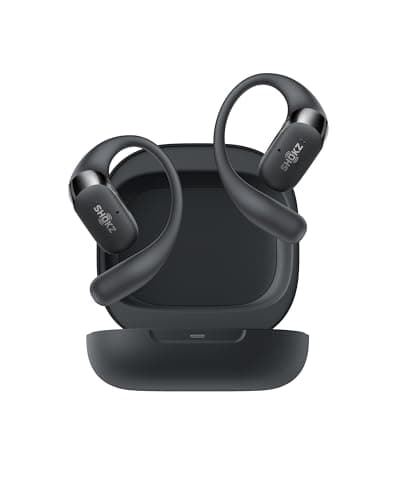
Shokz OpenFit 2
Open-ear hook8.3/10If sound is the deal-breaker: an air-conduction hook keeps the open canal, adds dual drivers and 11 hours, and weighs 9.4 g per side.
$179.95Amazon#ad · Price as of October 17, 2026 · Disclosure for the link to Shokz OpenFit 2
Best clip-on for sweat
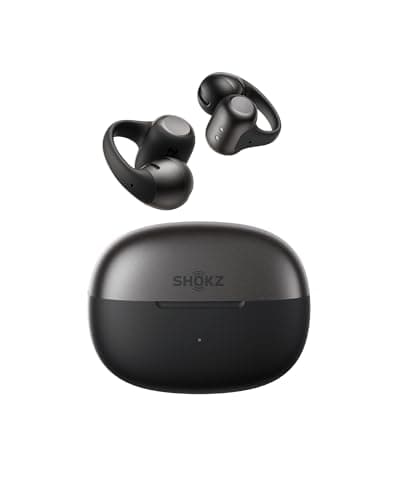
Shokz OpenDots 2
Open-ear clip-on8.6/10If weight and leakage are the deal-breakers: 6.4 g clip-ons with IP57 buds, an IP54 case and a bone-conduction call mic.
$199.95Amazon#ad · Price as of October 17, 2026 · Disclosure for the link to Shokz OpenDots 2
How we scored this
The research behind every pick
Each pair on this page is researched and compared the same way: we classify the retention system that holds it on (hook, clip, wing, neckband), read the maker's published IP rating, weight, battery, charging, mic and control type straight off its own product page and manual, check the sweat and water rating against the IEC 60529 standard, cross-reference independent published reviews, and score every pick on a public rubric. Every figure links to the document it came from, so you can check any number in one click.
Prices come live from Amazon, so what you see is what you pay today. Commissions never set a score or decide a pick. The rubric and its weights are published.
Questions
Frequently asked
What are the negatives of bone conduction headphones?
Why do bone conduction headphones sound bad?
Can other people hear bone conduction headphones?
Do bone conduction headphones vibrate uncomfortably?
Are bone conduction headphones bad for the gym?
Keep reading
Related on Openear Club
- Are they worth it?The same ledger with the advantages added back in.
- Open-ear vs bone conductionThe air-conduction alternative that keeps the open canal.
- Do they sound good?The sound drawback in full, with what DualPitch changes.
- Best bone conduction headphonesIf the drawbacks are acceptable, this is the ranking.
Receipts
Sources
- SoundGuys — Best bone conduction headphones, Chase Bernath, updated Jan 23, 2026 (checked 2026-09-21)
- Shokz — official product comparison table (checked 2026-09-21)
- Shokz — bone conduction technology page (checked 2026-09-21)
- SoundGuys — Suunto Wing review, Lil Katz, November 30, 2024, scored 7.1/10 (checked 2026-10-05)
- Shokz — OpenRun Pro 2 product page (checked 2026-09-21)
- Shokz — OpenDots 2 product page (checked 2026-09-21)
- Surendran, Prodanovic & Stenfelt, Hearing Through Bone Conduction Headsets, Trends in Hearing 27 (2023), NIH PMC (checked 2026-09-26)
Every spec here is traceable: figures come from the maker's own product pages and are linked on each product, independent findings are attributed to whoever published them, and prices come live from Amazon so the number you see is the number you pay today. Read the full method.